Computer Networks · M2 · read
Device, link, frame, packet and router
Only the basics you need
Prerequisites for CN M2
Definition. A computer network is a collection of interconnected devices that exchange data using agreed communication rules called protocols.
Simple meaning. Device number bhejta hai; link usko carry karta hai; protocol batata hai kaise bhejna hai.
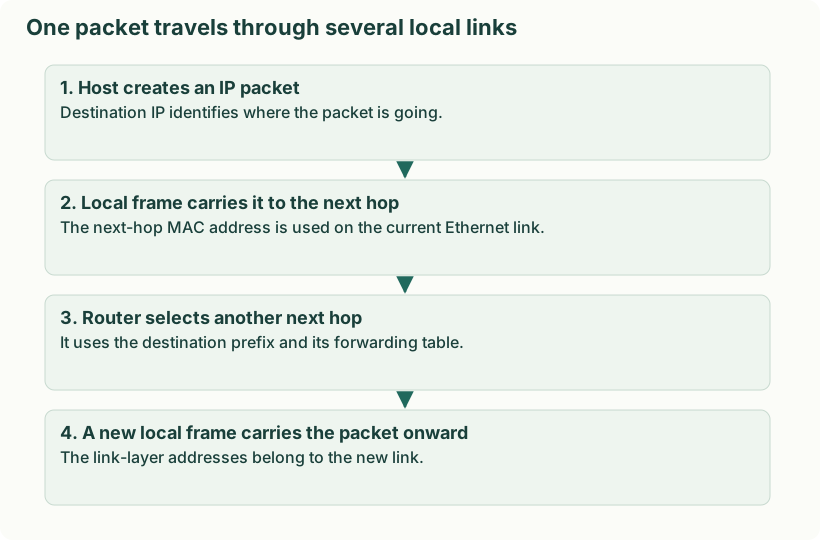
Diagram: One packet travels through several local links. Labels: One packet travels through several local links | One packet travels through several local links | 1. Host creates an IP packet | Destination IP identifies where the packet is going. | 2. Local frame carries it to the next hop | The next-hop MAC address is used on the current Ethernet link. | 3. Router selects another next hop | It uses the destination prefix and its forwarding table. | 4. A new local frame carries the packet onward | The link-layer addresses belong to the new link.
Understand it step by step
- A host is an end device such as a laptop. A link is the wired or wireless connection over which data travels.
- A bit is 0 or 1. A frame is the data-link unit carried over one link. A packet is the network-layer unit, such as an IP packet. A packet is normally carried inside a frame.
- A switch forwards Ethernet frames within a local network using MAC addresses. A router forwards IP packets between networks using destination IP addresses.
- An IP address identifies an interface logically. An Ethernet MAC address is used for delivery on the current local link. The local next-hop MAC can change at each routed hop.
Practice question. Distinguish a frame, a packet and the role of a router. [3 practice marks]
Answer
A frame is a data-link-layer unit for one-link delivery; an IP packet is a network-layer unit for delivery across interconnected networks. A router examines the destination IP address, selects a next hop and forwards the packet in a new link-layer frame.
Yaad rakho: Frame = ek link; packet = networks ke paar.