Computer Networks · TEE · mocks
Q7A · Shortest paths · full working
TEE mock A · full paper
TEE · 100 attempted marks · solutions for every choice · current syllabus 702AI0C023
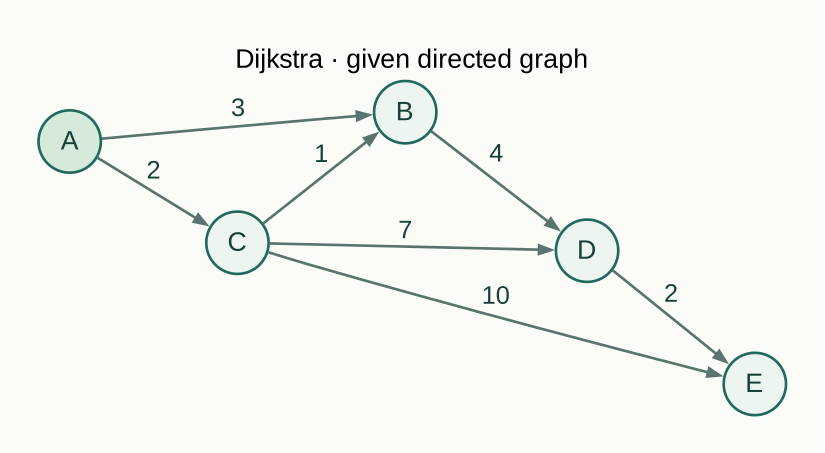
TEE practice mock · Q7A. For directed edges A→B=3, A→C=2, B→D=4, C→B=1, C→D=7, D→E=2, C→E=10, use Dijkstra from A to E. Show initialization, each settled vertex, updated distances and final path, and draw the network. [10 mock marks]
Answer
Given
| Edge | Cost |
|---|---|
| A→B | 3 |
| A→C | 2 |
| B→D | 4 |
| C→B | 1 |
| C→D | 7 |
| D→E | 2 |
| C→E | 10 |
Source=A; target=E. Edges are directed; do not add reverse edges.
To find
The path A to E, its total cost and intermediate work.
Formula and why
 LaTeX:
d[v]\leftarrow\min(d[v],d[u]+w(u,v))Use Dijkstra because all weights are nonnegative. Select the smallest unsettled total distance, not the cheapest isolated edge.
Step-by-step solution
Step 1. Initialize
d[A]=0; every other distance=∞. No predecessors are known.
| Vertex | Distance from A | Predecessor | State |
|---|---|---|---|
| A | 0 | — | Tentative |
| B | ∞ | — | Tentative |
| C | ∞ | — | Tentative |
| D | ∞ | — | Tentative |
| E | ∞ | — | Tentative |
Step 2. Settle A at distance 0
Unsettled candidates before selection: A=0, B=∞, C=∞, D=∞, E=∞. Select the minimum; ties use alphabetical order.
| Edge | Old distance | Candidate | Decision |
|---|---|---|---|
| A→B | ∞ | 0+(3)=3 | Improve to 3; predecessor=A |
| A→C | ∞ | 0+(2)=2 | Improve to 2; predecessor=A |
| Vertex | Distance from A | Predecessor | State |
|---|---|---|---|
| A | 0 | — | Settled |
| B | 3 | A | Tentative |
| C | 2 | A | Tentative |
| D | ∞ | — | Tentative |
| E | ∞ | — | Tentative |
Step 3. Settle C at distance 2
Unsettled candidates before selection: B=3, C=2, D=∞, E=∞. Select the minimum; ties use alphabetical order.
| Edge | Old distance | Candidate | Decision |
|---|---|---|---|
| C→B | 3 | 2+(1)=3 | Retain 3 (equal cost) |
| C→D | ∞ | 2+(7)=9 | Improve to 9; predecessor=C |
| C→E | ∞ | 2+(10)=12 | Improve to 12; predecessor=C |
| Vertex | Distance from A | Predecessor | State |
|---|---|---|---|
| A | 0 | — | Settled |
| B | 3 | A | Tentative |
| C | 2 | A | Settled |
| D | 9 | C | Tentative |
| E | 12 | C | Tentative |
Step 4. Settle B at distance 3
Unsettled candidates before selection: B=3, D=9, E=12. Select the minimum; ties use alphabetical order.
| Edge | Old distance | Candidate | Decision |
|---|---|---|---|
| B→D | 9 | 3+(4)=7 | Improve to 7; predecessor=B |
| Vertex | Distance from A | Predecessor | State |
|---|---|---|---|
| A | 0 | — | Settled |
| B | 3 | A | Settled |
| C | 2 | A | Settled |
| D | 7 | B | Tentative |
| E | 12 | C | Tentative |
Step 5. Settle D at distance 7
Unsettled candidates before selection: D=7, E=12. Select the minimum; ties use alphabetical order.
| Edge | Old distance | Candidate | Decision |
|---|---|---|---|
| D→E | 12 | 7+(2)=9 | Improve to 9; predecessor=D |
| Vertex | Distance from A | Predecessor | State |
|---|---|---|---|
| A | 0 | — | Settled |
| B | 3 | A | Settled |
| C | 2 | A | Settled |
| D | 7 | B | Settled |
| E | 9 | D | Tentative |
Step 6. Settle E at distance 9
Unsettled candidates before selection: E=9. Select the minimum; ties use alphabetical order.
No outgoing edges to relax.
| Vertex | Distance from A | Predecessor | State |
|---|---|---|---|
| A | 0 | — | Settled |
| B | 3 | A | Settled |
| C | 2 | A | Settled |
| D | 7 | B | Settled |
| E | 9 | D | Settled |
Step 7. Recover the path
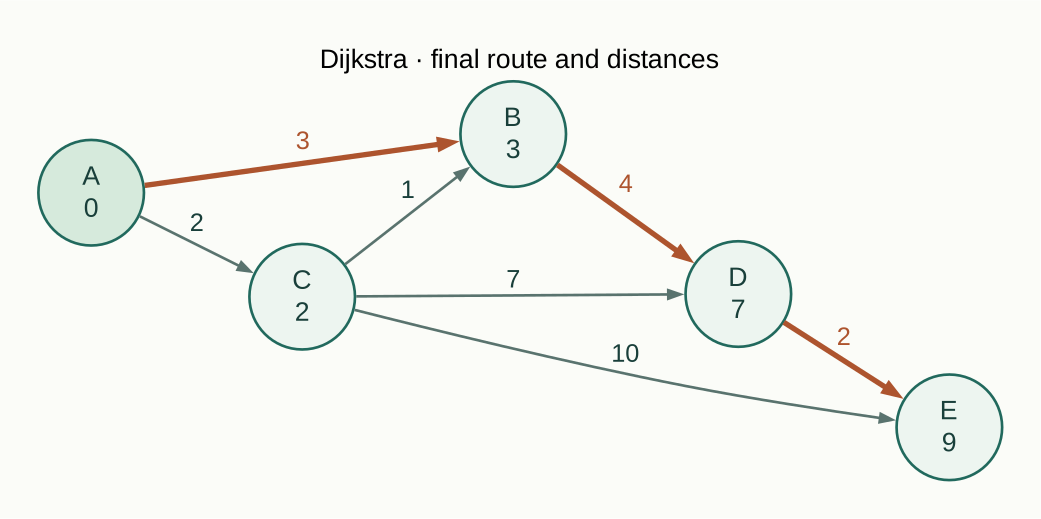
Trace backwards: E ← D ← B ← A. Reverse it: A → B → D → E.
Edge sum: 3 + 4 + 2 = 9.
Final answer: A → B → D → E; cost=9.