Computer Networks · TEE · mocks
Q3B · OSPF
TEE mock B · full paper
TEE · 100 attempted marks · solutions for every choice · current syllabus 702AI0C023
TEE practice mock · Q3B. Summarize how OSPF determines the best path to a destination network. [5 mock marks]
Answer
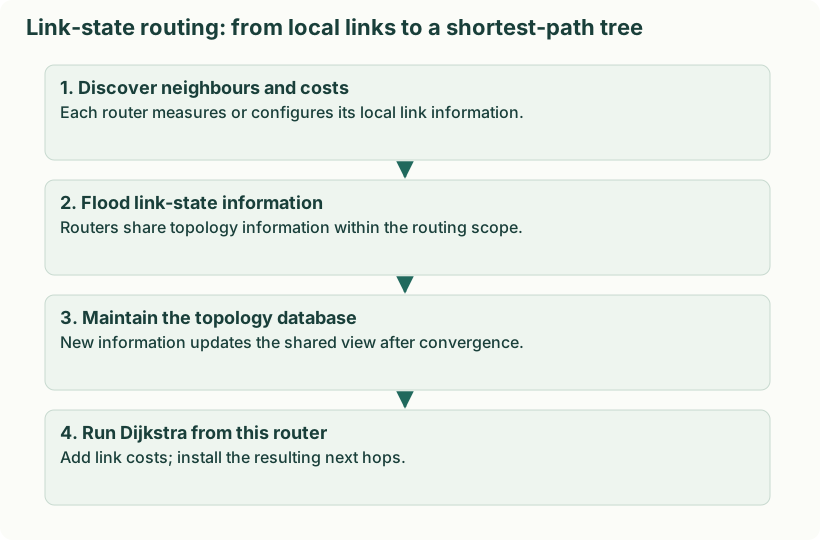
Diagram: Link-state routing: from local links to a shortest-path tree. Labels: Link-state routing: from local links to a shortest-path tree | Link-state routing: from local links to a shortest-path tree | 1. Discover neighbours and costs | Each router measures or configures its local link information. | 2. Flood link-state information | Routers share topology information within the routing scope. | 3. Maintain the topology database | New information updates the shared view after convergence. | 4. Run Dijkstra from this router | Add link costs; install the resulting next hops.
- Discover/maintain neighbours and determine local link costs.
- Exchange link-state information and synchronize the database within the appropriate area.
- Run Dijkstra’s shortest-path algorithm with the current router as the root.
- Add outgoing link costs along candidate paths and select minimum-cost routes.
- Install next-hop information; recalculate when relevant topology information changes.