Computer Networks · TEE · mocks
Q7B · Traffic-shaping algorithm
TEE mock B · full paper
TEE · 100 attempted marks · solutions for every choice · current syllabus 702AI0C023
TEE practice mock · Q7B. Draw and explain the leaky-bucket algorithm. Is it always better than a token bucket? [10 mock marks]
Answer
In the textbook leaky-bucket queue/shaper model, arriving packets enter a finite buffer. The output sends at a configured rate whenever data is queued. When the queue empties, it cannot send nonexistent packets; when the buffer is full, excess arrivals are dropped in this finite-buffer model.
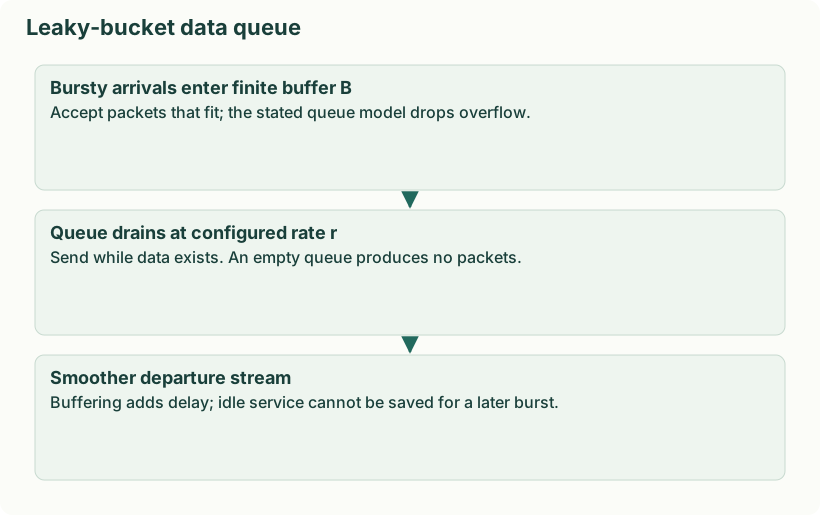
- Choose buffer capacity B and output service rate r in consistent units.
- Admit arrivals that fit. Drop/mark overflow according to the stated implementation; this queue example drops the excess.
- Drain at rate r while the queue is nonempty. Idle time does not accumulate permission for a later faster burst.
- The result is smoothed output. Larger buffers accommodate larger bursts but can increase waiting delay.
| Advantage | Limitation |
|---|---|
| Simple bound on output rate | Bursts may overflow or suffer delay |
| Reduces short-term output variation | Unused idle service cannot be saved |
| Useful for predictable traffic shaping | No end-to-end delay/loss guarantee by itself |
The term “leaky bucket” can also describe a conformance meter in standards. This course’s diagrams and numerical questions explicitly use the finite data-queue model, so its state is queued data rather than tokens.
No algorithm is universally better. The leaky data-queue model is useful for a smooth output profile; token bucket is preferable when controlled bursts should be allowed. State the application’s delay, burst and rate needs before recommending one.