Computer Networks · TEE · mocks
Q1B · Reference models
TEE mock C · full paper
TEE · 100 attempted marks · solutions for every choice · current syllabus 702AI0C023
TEE practice mock · Q1B. Draw the OSI reference model and explain the function of each layer. [5 mock marks]
Answer
The Open Systems Interconnection (OSI) model separates network functions into seven layers. A layer offers services upward and uses services below. Peer layers communicate logically through protocol rules; actual data moves down the sender’s stack, across links and up the receiver’s stack.
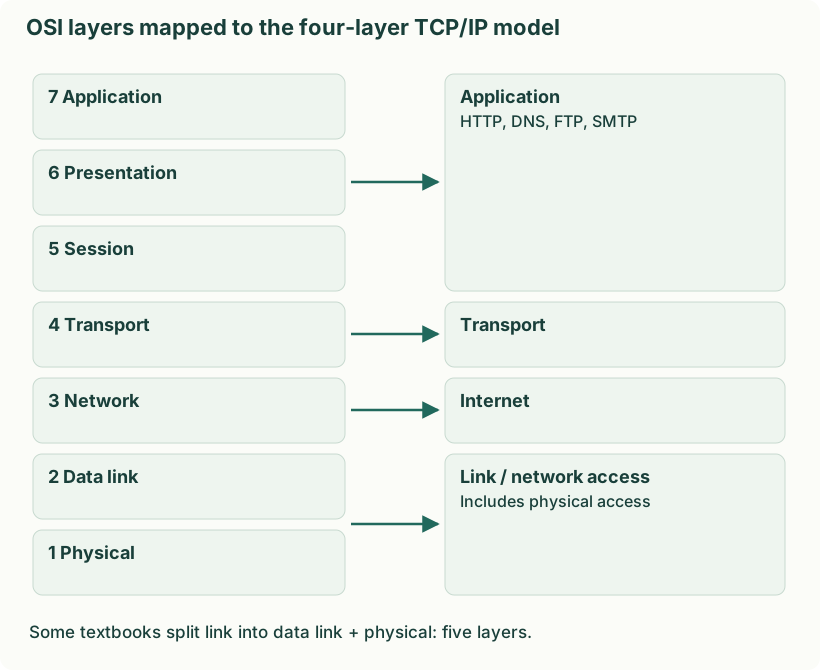
Diagram: OSI layers mapped to the four-layer TCP/IP model. Labels: OSI layers mapped to the four-layer TCP/IP model | OSI layers mapped to the four-layer TCP/IP model | 7 Application | 6 Presentation | 5 Session | 4 Transport | 3 Network | 2 Data link | 1 Physical | Application | HTTP, DNS, FTP, SMTP | Transport | Internet | Link / network access | Includes physical access | Some textbooks split link into data link + physical: five layers.
| Layer | Task | Example |
|---|---|---|
| 7 Application | Services used by network applications | HTTP, DNS, FTP, SMTP |
| 6 Presentation | Representation, encoding and application data transformations | Character encoding, serialization; encryption as a conceptual function |
| 5 Session | Manage dialogue and synchronization/checkpoints | Session establishment and resumption concepts |
| 4 Transport | Process delivery; reliability/flow control where supplied | TCP, UDP, SCTP; ports |
| 3 Network | Logical addressing and routing across networks | IP; routers |
| 2 Data link | Framing, local link addressing, medium access and error detection | Ethernet/Wi-Fi; MAC addresses |
| 1 Physical | Transmit signal symbols/bits through a medium | Electrical, optical or radio signals |
Encapsulation and delivery
- Application creates data. Transport adds a transport header: TCP segment or UDP datagram.
- IP adds its header to form a packet. The link adds a header and usually a trailer to form a frame.
- The physical layer carries signals. The destination reverses the process and sends the data to the receiving process.
- At a router, local framing changes for the next link. A transit router primarily forwards at Layer 3; it need not run the end application.