Computer Networks · TEE · mocks
Q4A · IPv6 and packet headers
TEE mock C · full paper
TEE · 100 attempted marks · solutions for every choice · current syllabus 702AI0C023
TEE practice mock · Q4A. Summarize the IPv6 address 0:15::1:12:1213 to its full, original form. Write a comparison between IPv4 and IPv6 packet headers. [10 mock marks]
Answer
Given
Given address: 0:15::1:12:1213.
To find
The full 128-bit address in eight-group hexadecimal notation.
Formula and why
 LaTeX:
\text{missing groups}=8-\text{visible groups}A written 0 is a visible group. :: represents only the omitted all-zero groups.
Step-by-step solution
Step 1. Count groups on both sides
Left: 0, 15 (2 group(s)). Right: 1, 12, 1213 (3 group(s)).
Step 2. Calculate omitted groups
Visible=2+3=5. Missing=8−5=3.
Step 3. Insert the groups
0:15:0:0:0:1:12:1213.
Step 4. Pad each group on the left
| Group number | Four-digit group |
|---|---|
| 1 | 0000 |
| 2 | 0015 |
| 3 | 0000 |
| 4 | 0000 |
| 5 | 0000 |
| 6 | 0001 |
| 7 | 0012 |
| 8 | 1213 |
Step 5. Write all eight in order
0000:0015:0000:0000:0000:0001:0012:1213.
Final answer: 0000:0015:0000:0000:0000:0001:0012:1213
Header comparison
| Feature | IPv4 | IPv6 |
|---|---|---|
| Address width | 32 bits | 128 bits |
| Base/header size | 20–60 bytes depending on options | 40-byte fixed base header |
| Length field | Total length includes IPv4 header | Payload Length excludes 40-byte base header |
| Lifetime field | TTL | Hop Limit |
| Following protocol | Protocol field | Next Header; may identify an extension |
| Header checksum | Present | No base-header checksum |
| Options | Inside IPv4 header | Typically extension headers |
| Fragmentation fields | In IPv4 header; routers may fragment if permitted | Fragment extension header; fragmentation by source, not routers |
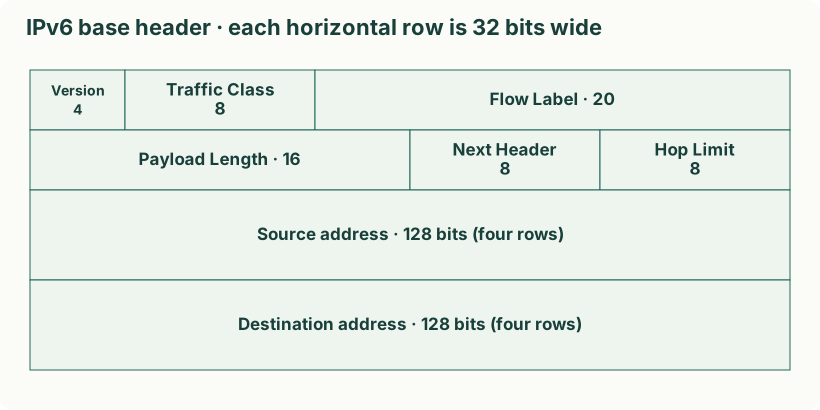
Diagram: IPv6 base header · each horizontal row is 32 bits wide. Labels: IPv6 base header · each horizontal row is 32 bits wide | IPv6 base header · each horizontal row is 32 bits wide | Version | 4 | Traffic Class | 8 | Flow Label · 20 | Payload Length · 16 | Next Header | 8 | Hop Limit | 8 | Source address · 128 bits (four rows) | Destination address · 128 bits (four rows)
The supplied scheme’s sentence says four missing groups, but five groups are already visible, so only three are missing. Its printed eight-group expansion is consistent with three. The count shown above is independently verified.