Computer Networks · TEE · mocks
Q6B · Random access
TEE mock C · full paper
TEE · 100 attempted marks · solutions for every choice · current syllabus 702AI0C023
TEE practice mock · Q6B. Compare 1-persistent, non-persistent, and p-persistent CSMA strategies with diagrammatic representations. [5 mock marks]
Answer
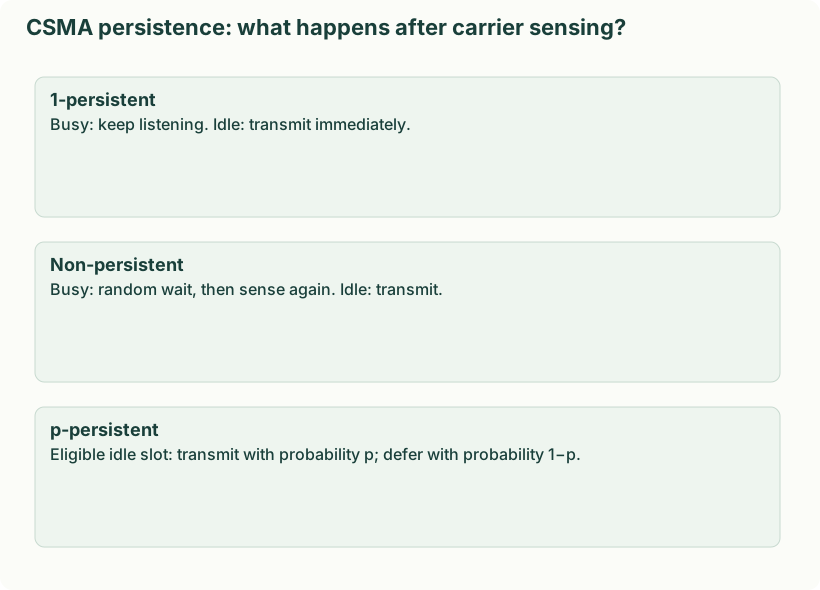
Diagram: CSMA persistence: what happens after carrier sensing?. Labels: CSMA persistence: what happens after carrier sensing? | CSMA persistence: what happens after carrier sensing? | 1-persistent | Busy: keep listening. Idle: transmit immediately. | Non-persistent | Busy: random wait, then sense again. Idle: transmit. | p-persistent | Eligible idle slot: transmit with probability p; defer with probability 1−p.
| Rule | When idle | When busy | Trade-off |
|---|---|---|---|
| 1-persistent | Transmit immediately | Keep listening; transmit as soon as idle | Low idle delay, but waiting stations may start together |
| Non-persistent | Transmit | Wait a random time, then sense again | Less synchronized contention; may leave avoidable idle time |
| p-persistent (slotted) | Transmit with probability p; defer a slot with probability 1−p | Wait until available, then resume the probabilistic slot rule | Controls contention; needs slots and a choice of p |
All three sense the channel; their persistence rules differ. Propagation delay means carrier sensing cannot guarantee the absence of collisions. In p-persistent CSMA, each eligible idle-slot decision uses the specified probability.