Computer Networks · TEE · papers
Q4(b) · Selective Repeat scenarios
2023-11-22 · Final 2023-24 / Re-exam 2022-23
Actual paper; 100 marks attempted. Current-syllabus alignment is stated per question.
Q4(b). Illustrate the working of selective repeat ARQ with the help of frame transmission scenarios. Give any one advantage and disadvantage. [10 marks]
Answer
Selective Repeat (SR) ARQ accepts and buffers valid out-of-order frames inside the receiver window, acknowledges them individually and retransmits only missing/timed-out frames. In this answer ACK i means “frame i received”, unlike the next-expected cumulative ACK convention used for GBN.
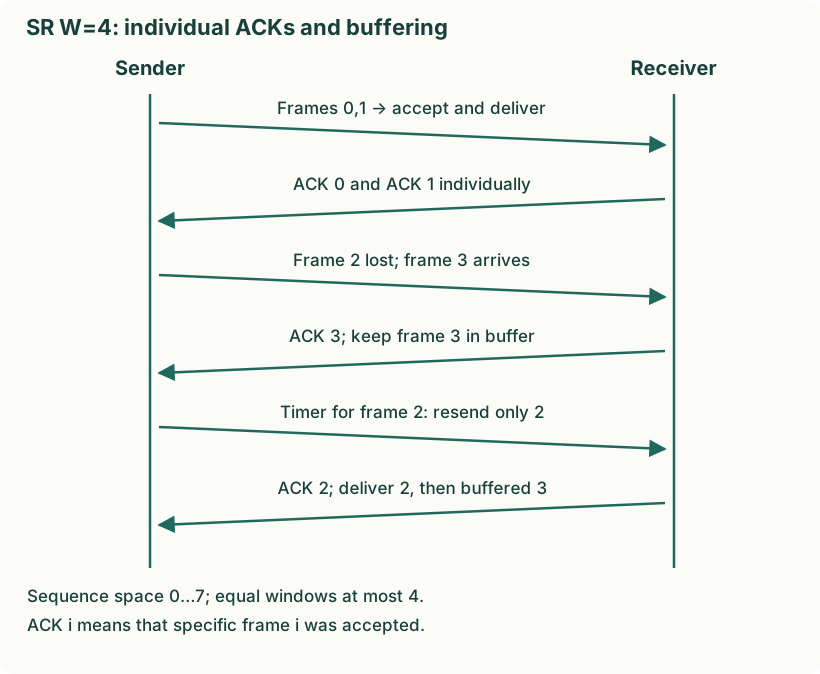
Diagram: SR W=4: individual ACKs and buffering. Labels: SR W=4: individual ACKs and buffering | SR W=4: individual ACKs and buffering | Sender | Receiver | Frames 0,1 → accept and deliver | ACK 0 and ACK 1 individually | Frame 2 lost; frame 3 arrives | ACK 3; keep frame 3 in buffer | Timer for frame 2: resend only 2 | ACK 2; deliver 2, then buffered 3 | Sequence space 0…7; equal windows at most 4. | ACK i means that specific frame i was accepted.
- For m=3 there are eight sequence numbers, 0…7. With equal sender and receiver windows, maximum W=23−1=4. Both windows begin at 0 and span 0…3.
- Sender sends 0,1,2,3. Receiver accepts 0 and 1, delivers them and advances its left edge to 2. Frame 2 is lost; frame 3 is stored and ACK 3 is sent.
- Although 3 is acknowledged, the sender’s base cannot jump over missing 2. A timer for 2 expires; only frame 2 is retransmitted.
- When 2 arrives, the receiver can deliver 2 and the buffered 3 in order, moving its window forward. Individual ACKs let the sender release the relevant stored copies.
- Why half the space: with an incorrectly chosen W=5 in an eight-number space, receiving old 0…4 moves the receive window to {5,6,7,0,1}. If ACKs are lost, retransmitted old 0 or 1 could fall in the new window and be mistaken for new data. W=4 prevents these two consecutive windows from overlapping.
- A repeated old frame can be acknowledged again without delivering it twice. SR needs more receiver storage and per-frame tracking than GBN.
 LaTeX:
W_s=W_r\le 2^{m-1}Yaad rakho: SR selective resend; half sequence space keeps old and new separate.
Transmission cases and evaluation
| Case | Receiver action | Sender action |
|---|---|---|
| Normal transmission | Accept valid frames in its window; deliver the contiguous in-order sequence; ACK each frame | Send within the window and advance its base when the earliest outstanding frames are acknowledged |
| Lost data frame | Buffer later valid frames and ACK them, leaving the missing gap | On the missing frame's timeout, retransmit only that frame |
| Lost ACK | If an already accepted frame is repeated, acknowledge it again without delivering it twice | The individual timer may expire and repeat that one frame; the repeated ACK ends recovery |
Advantage: selective retransmission saves link capacity after isolated loss. Disadvantage: buffering out-of-order frames and tracking individual timers/ACKs make the receiver and sender more complex.