Computer Networks · TEE · papers
Q2(c) · ARP response destination
2024-12-06 · AI-only Sem V variant
Exact historical variant. Current-syllabus questions solved; excluded topics and source limitations stated.
Q2(c). Why is an ARP response normally sent to a specific destination MAC address rather than broadcast? [5 marks]
Answer
Definition. Address Resolution Protocol (ARP) resolves a known IPv4 address to a link-layer hardware address on the local network.
Simple meaning. IP pata hai; local delivery ke liye MAC chahiye.
Understand it step by step
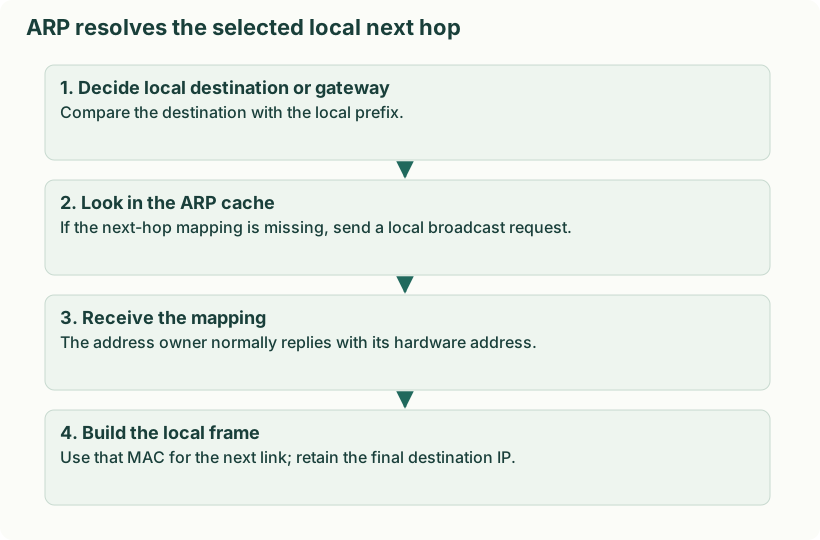
- First determine whether the destination is on the local subnet. If local, the next hop is the destination itself. If remote, the next hop is a router such as the default gateway.
- Check the ARP cache. If the next-hop mapping is absent, broadcast an ARP request on the local link.
- The owner of the requested IPv4 address normally replies with its hardware address. The sender caches the mapping and constructs its data frame.
- Routers do not normally forward a host’s ARP broadcast across networks. ARP resolves the next hop, not the MAC of a remote Internet server.
ARP maps a known local next-hop IPv4 address to a hardware address. A sender broadcasts a request when the mapping is missing; the address owner replies, and the mapping is cached. For a remote IP destination, the sender resolves its gateway’s local MAC address, then forwards the packet toward that gateway.
Yaad rakho: Remote packet ka next-hop MAC gateway ka hota hai.
The request already contains the requester’s MAC address. The owner of the requested IP can therefore address its reply directly to that MAC. Unicast avoids making every LAN host process a reply intended for one requester and reduces unnecessary traffic. Ordinary request is broadcast because the destination MAC was unknown; ordinary response is unicast because it is now known. Gratuitous/announcement ARP is a different case and can be broadcast.