Computer Networks · TEE · papers
Q3(c) · Reliable application over UDP
2024-12-06 · AI-only Sem V variant
Exact historical variant. Current-syllabus questions solved; excluded topics and source limitations stated.
Q3(c). Can an application achieve reliable transfer while running over UDP? If so, how? [5 marks]
Answer
User Datagram Protocol (UDP) provides connectionless, message-oriented process delivery. One send creates a datagram; message boundaries are retained. UDP has an 8-byte header, carries ports and length, and offers checksum-based corruption detection. It does not itself guarantee delivery, ordering, duplicate suppression, retransmission, flow control or congestion control.
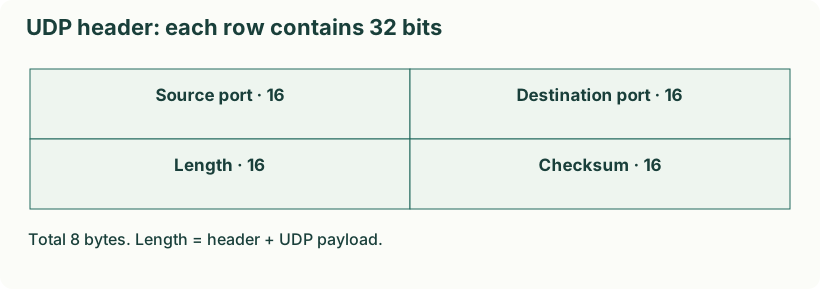
| UDP field | Width | Purpose |
|---|---|---|
| Source port | 16 bits | Sending endpoint; a zero value can indicate no reply port when unused |
| Destination port | 16 bits | Receiving application endpoint |
| Length | 16 bits | UDP header plus UDP payload; minimum 8 bytes |
| Checksum | 16 bits | Error detection over UDP and an IP pseudo-header; not retransmission |
Operation and services
- The application chooses the destination IP/port and supplies a message. UDP adds its header and passes the datagram to IP without a connection handshake.
- The receiving UDP layer validates the length/checksum as applicable and uses the destination endpoint to deliver the datagram.
- A corrupt or undeliverable datagram may be discarded; UDP does not recover it. Any reliability or rate-control policy must come from the application or a protocol above UDP.
- UDP checksum zero can mean checksum omitted in IPv4. IPv6 ordinarily requires the UDP checksum; specialized exceptions are outside this syllabus.
Yaad rakho: UDP datagram preserve; reliability automatic nahi.
Yes, reliability can be implemented above UDP. Add sequence numbers, acknowledgments, checksums, retransmission timers, duplicate suppression, ordering buffers and flow/congestion handling as required. If packet5 is lost, an application-level timeout retransmits5; a receiver seeing a duplicate5 acknowledges it without delivering it twice. UDP itself still supplies no delivery guarantee: the application protocol supplies these mechanisms and may eventually report failure rather than guarantee delivery across a permanent outage.