Computer Networks · TEE · papers
Q1(d) · Circuit versus packet switching
2024-02-06 · 2022-23
Actual paper; 100 marks attempted. Current-syllabus alignment is stated per question.
Q1(d). Distinguish between circuit switching and packet switching (Any 5 points for each) [5 marks]
Answer
Definition. Switching selects how data passes through intermediate network nodes from a source to a destination.
Simple meaning. Raasta reserve karna, poora message ruk-ruk ke bhejna, ya chhote packets bhejna—yeh teen ideas hain.
Understand it step by step
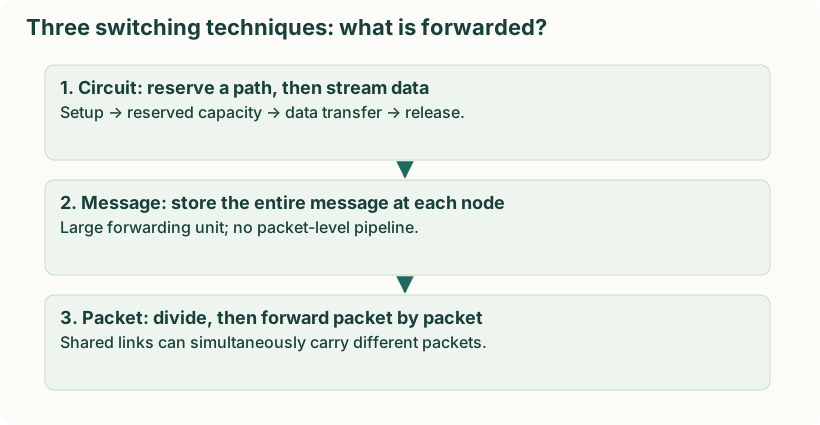
- Circuit switching: establish a circuit, reserve resources, transfer data, then release the circuit. Capacity is dedicated even during a silent period.
- Message switching: each intermediate node receives the entire message before forwarding it. Large messages require large buffers and can delay later messages.
- Packet switching: divide data into smaller packets. Nodes forward packets individually; different links can carry successive packets at the same time.
- The Internet uses packet switching. A traditional circuit-switched telephone call illustrates the circuit concept. Many current calls use packet-based networks, so do not label every phone call circuit-switched.
| Aspect | Circuit switching | Message switching | Packet switching |
|---|---|---|---|
| Unit handled | Continuous stream on established circuit | Whole message | Small packets |
| Resource use | Capacity reserved along a circuit | Shared; message stored at each intermediate node | Shared; each packet stored/forwarded in this model |
| Setup | Required before data transfer | No circuit setup required | Datagram: no connection setup; virtual circuit: setup |
| Delay | Setup delay, then relatively predictable service | Large store-and-forward delay for long messages | Variable delay; packet pipeline can reduce completion time |
| Main limitation | Reserved capacity can be idle | Large buffers; unsuitable for tight delay needs | Headers, possible queueing/loss; datagrams may reorder |
For ordinary bursty office data, packet switching is generally appropriate because resources are shared among active transfers. The design must still account for queueing, loss and the required service quality.
Yaad rakho: Circuit reserves; message waits whole; packets pipeline.
Two advantages and two disadvantages
| Method | Advantage 1 | Advantage 2 | Disadvantage 1 | Disadvantage 2 |
|---|---|---|---|---|
| Message switching | Shares link capacity without a permanently reserved circuit | Intermediate storage lets a message wait for a currently busy outgoing link | The entire message must arrive before forwarding, giving long delay | Large messages require large buffers and can hold up other messages |
| Packet switching | Statistical sharing suits bursty data from many users | Packets can be pipelined across successive links, reducing completion time | Every packet needs header/control overhead | Queueing, loss and (for datagrams) reordering need endpoint or network handling |
A packet-switched network may use datagrams or virtual circuits. The possibility of independent routes and reordering refers to datagrams, not every packet-switching implementation.