Computer Networks · TEE · papers
Q5(a) · Go-Back-N scenarios
2024-02-06 · 2022-23
Actual paper; 100 marks attempted. Current-syllabus alignment is stated per question.
Q5(a). Illustrate the working of Go-Back N ARQ with the help of frame transmission scenarios. Give any one advantage and disadvantage. [10 marks]
Answer
Go-Back-N (GBN) ARQ pipelines up to W outstanding frames. For m-bit sequence numbers, textbook GBN uses W ≤ 2m−1 and receiver window 1. The receiver accepts only the next in-order frame; out-of-order frames are discarded. ACK k here cumulatively acknowledges all frames before k and means “next expected is k”.
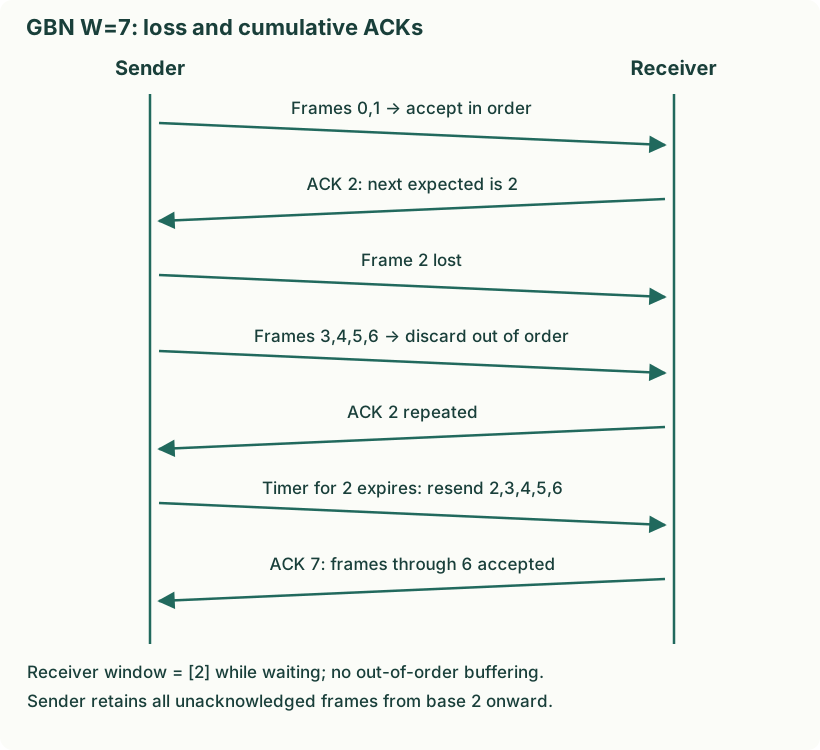
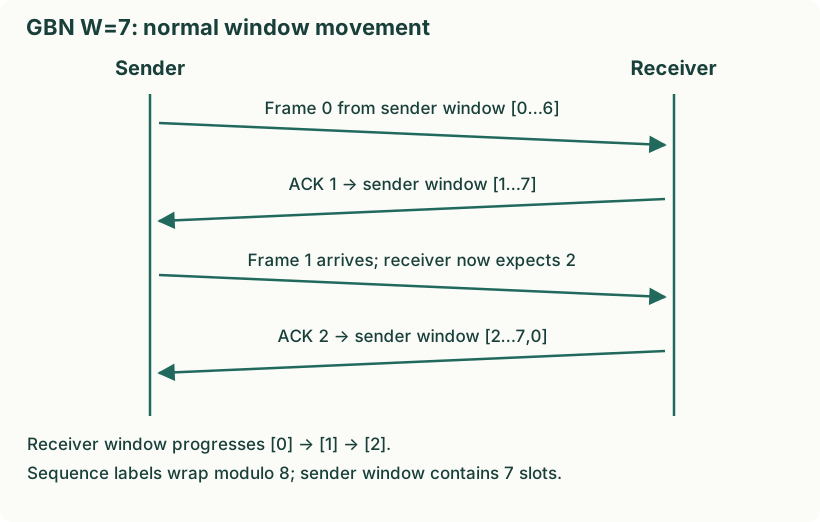
- For W=7 with m=3, the sequence space is 0…7. Initially the sender can transmit 0…6. It stores every unacknowledged frame; a timer tracks the oldest one.
- Normal: after receiving 0 and 1, cumulative ACK 2 advances the sender base to 2. The sender can fill newly opened window slots.
- Lost data: if frame 2 is lost, frames 3…6 arrive out of order and are discarded. Repeated ACK 2 says frame 2 is still expected. On timeout the sender retransmits all outstanding frames starting at 2, here 2…6.
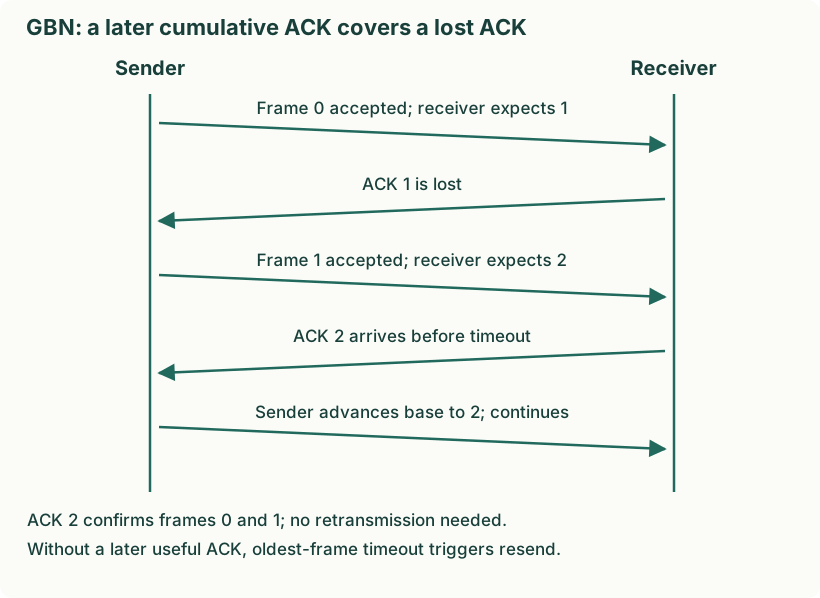
- Lost ACK: if ACK 2 is lost but ACK 3 arrives, the later cumulative ACK confirms frames 0…2 and avoids unnecessary retransmission. If no later useful ACK arrives before timeout, the sender retransmits from its oldest outstanding frame; the receiver rejects duplicates and sends its current ACK.
- After sequence 7, numbers wrap to 0. The bound W ≤ 7 leaves one sequence value outside the sender’s current window, preventing the all-ACKs-lost ambiguity of a full eight-frame window in the textbook model.
Yaad rakho: GBN receiver one; gap ke baad discard; timeout pe outstanding suffix repeat.
One advantage and one disadvantage
Advantage: pipelining improves utilization over Stop-and-Wait while retaining a simple one-frame receiver window. Disadvantage: after a gap, the receiver discards later frames, so a timeout can force retransmission of several frames that arrived correctly.