Computer Networks · TEE · papers
Q2(b) · CSMA/CD
2024-12-06 · Final 2024-25 / Re-exam 2023-24
Actual paper; 100 marks attempted. Current-syllabus alignment is stated per question.
Q2(b). Explain the working of CSMA/CD with flow diagram. [10 marks]
Answer
Definition. CSMA with Collision Detection monitors the medium during transmission, aborts a detected collision and retries after a randomized backoff.
Simple meaning. CD = takkar detect hui toh transmission rok do.
Understand it step by step
- Sense the channel. In traditional shared half-duplex Ethernet, begin transmission when permitted by the access rule.
- Continue monitoring while transmitting. If a collision is detected, send the collision/jam indication and abort the current frame.
- Choose a random delay using binary exponential backoff; then attempt again subject to the access rules.
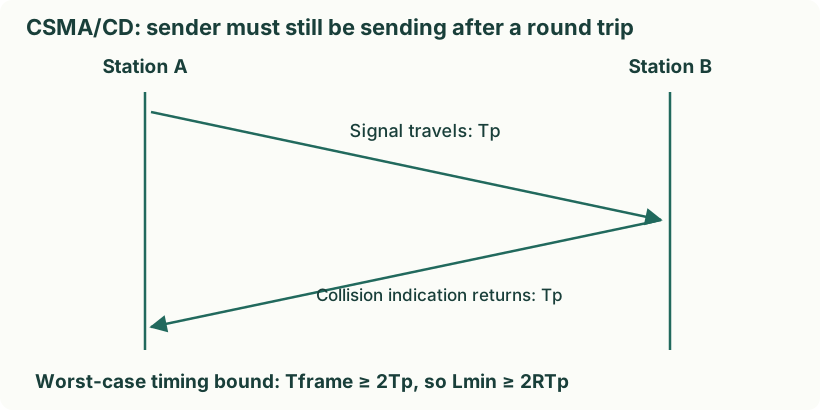
- The sender must still be transmitting when a worst-case collision indication returns. Hence the ideal timing requirement is Tframe ≥ 2Tp.
- Modern switched full-duplex Ethernet links do not use collision-based CSMA/CD access. Keep the historical/shared-medium assumptions explicit.
 LaTeX:
T_{\mathrm{frame}}\geq 2T_p LaTeX:
L_{\min}\geq 2RT_pCSMA/CD senses before transmission and detects collisions during transmission. A collision causes abort/jam and a random backoff before retry. To detect the most distant collision before the frame finishes, the transmission duration must be at least the worst-case round-trip propagation delay. Thus Lmin/R ≥ 2Tp in the idealized model.
Yaad rakho: Detect karna hai toh sender tab tak bhej raha hona chahiye.
CSMA/CD flow diagram
Frame ready → sense channel
                 │
          Busy? yes → keep sensing (1-persistent case)
                 no
                 ↓
          Transmit and monitor
                 │
          Collision? no → frame finished? → success
                 yes
                 ↓
          Jam indication → abort frame → increment attempt count
                 │
          Retry limit reached? yes → report failure
                 no
                 ↓
          Random binary-exponential backoff → sense again
For Ethernet, the backoff range grows with collisions, capped after the specified stage; transmission is abandoned at the retry limit. Carrier sensing must still be obeyed after the random delay.