Computer Networks · TEE · papers
Q1(b) · Stop-and-Wait losses
2025-02-19 · 2023-24 / 2024-25
Actual paper; 100 marks attempted. Current-syllabus alignment is stated per question.
Q1(b). Describe how the Stop-and-Wait ARQ protocol addresses the issues of lost data packets and lost acknowledgments to ensure reliable data transmission? [5 marks]
Answer
Stop-and-Wait ARQ permits only one outstanding frame. The sender stores its frame, transmits it and starts a timer. A valid matching ACK advances the sender; a timeout retransmits the stored frame.
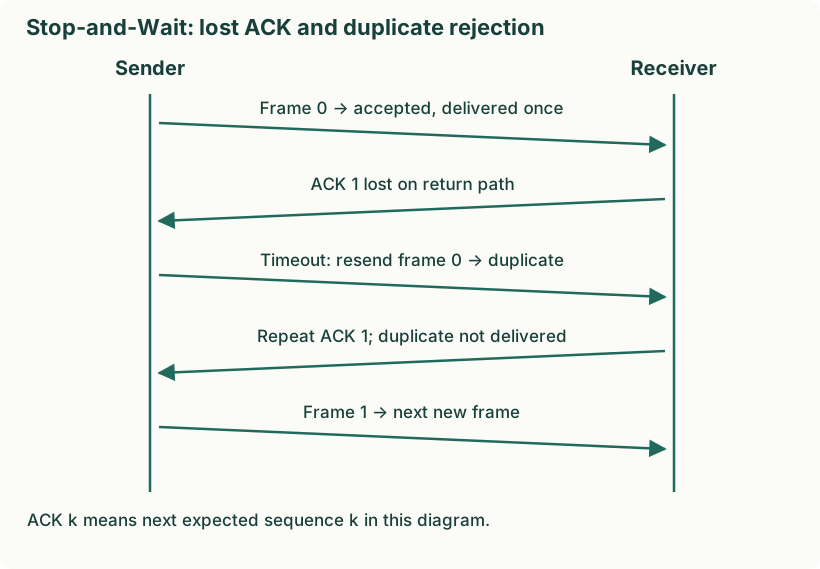
Diagram: Stop-and-Wait: lost ACK and duplicate rejection. Labels: Stop-and-Wait: lost ACK and duplicate rejection | Stop-and-Wait: lost ACK and duplicate rejection | Sender | Receiver | Frame 0 → accepted, delivered once | ACK 1 lost on return path | Timeout: resend frame 0 → duplicate | Repeat ACK 1; duplicate not delivered | Frame 1 → next new frame | ACK k means next expected sequence k in this diagram.
- Use alternating sequence numbers 0 and 1. The receiver remembers the next expected number. Here ACK k means the next sequence expected.
- Normal: send frame 0, receiver accepts it and sends ACK 1; sender then sends frame 1.
- Damaged/lost data: receiver cannot accept the missing valid frame. The sender eventually times out and retransmits.
- Lost ACK: the receiver already accepted the frame, but the sender times out and retransmits it. The receiver detects the duplicate by sequence number, does not deliver it twice, and repeats the ACK.
- A damaged ACK must not advance the sender. The timer provides eventual recovery. Waiting each round trip limits utilization on high-delay links.
Yaad rakho: One frame outstanding; duplicate ko acknowledge karo, deliver dobara nahi.