Computer Networks · TEE · papers
Q1(c) · SCTP services
2025-02-19 · 2023-24 / 2024-25
Actual paper; 100 marks attempted. Current-syllabus alignment is stated per question.
Q1(c). Explain any 5 services of SCTP. [5 marks]
Answer
Stream Control Transmission Protocol (SCTP) is a reliable message-oriented transport. A relationship between endpoints is an association. Its packets contain a common header followed by chunks, which carry data or control information.
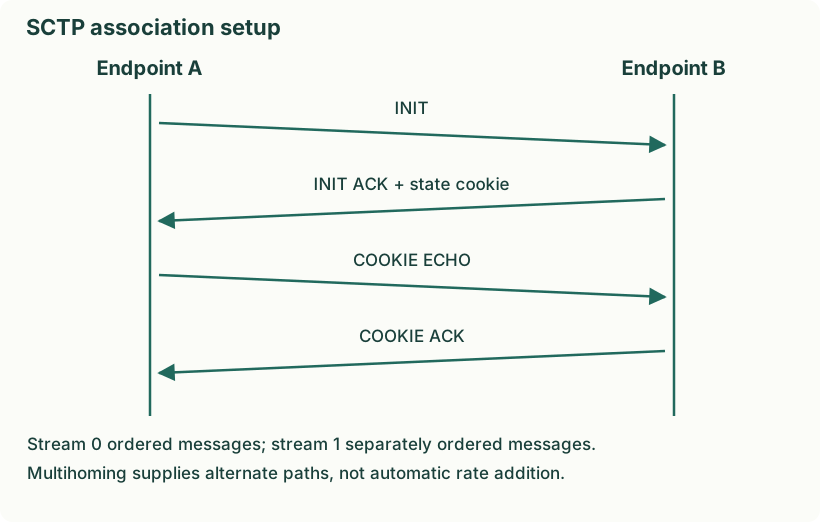
Diagram: SCTP association setup. Labels: SCTP association setup | SCTP association setup | Endpoint A | Endpoint B | INIT | INIT ACK + state cookie | COOKIE ECHO | COOKIE ACK | Stream 0 ordered messages; stream 1 separately ordered messages. | Multihoming supplies alternate paths, not automatic rate addition.
- INIT → INIT ACK → COOKIE ECHO → COOKIE ACK is the normal setup. The state cookie helps avoid committing full association resources solely on an initial request.
- Data is organized into messages on streams. Transmission Sequence Numbers track reliable chunk delivery across the association; ordering information identifies order within an ordered stream.
- Multiple streams allow a missing message in one stream to avoid forcing every other stream to wait for that stream’s ordering. They still share association/network resources, so this does not guarantee total independence.
- Multihoming lets endpoints advertise multiple addresses, supporting alternate paths and failover. Standard multihoming does not automatically mean all paths’ bandwidth is aggregated.
- SCTP supplies retransmission, selective acknowledgements, receiver flow control and congestion control. Its common header is 12 bytes; chunks add their own headers and data.
Yaad rakho: SCTP association: streams separate order, addresses provide failover.
Five SCTP services
| Service | Explanation |
|---|---|
| Process-to-process delivery | Port numbers identify the sending and receiving applications |
| Reliable message delivery | Checks, sequence tracking, acknowledgements and retransmission recover missing chunks while preserving messages |
| Multistreaming | Separate ordering within streams reduces cross-stream ordering blockage |
| Multihoming | Multiple endpoint addresses permit an alternate path if the primary fails |
| Flow and congestion control | Receiver flow control limits receiver overload; congestion control adapts traffic to network conditions |