Computer Networks · TEE · papers
Q2(b) · CSMA/CA and RTS/CTS
2025-02-19 · 2023-24 / 2024-25
Actual paper; 100 marks attempted. Current-syllabus alignment is stated per question.
Q2(b). Explain in detail CSMA/CA with the help of a diagram. Describe the role of RTS and CTS in avoiding collision in CSMA/CA. [10 marks]
Answer
Definition. CSMA with Collision Avoidance uses carrier sensing and randomized access delays, with acknowledgements and optional reservation exchanges, to reduce collisions on a wireless shared medium.
Simple meaning. CA = pehle collision avoid karne ki koshish; guarantee nahi.
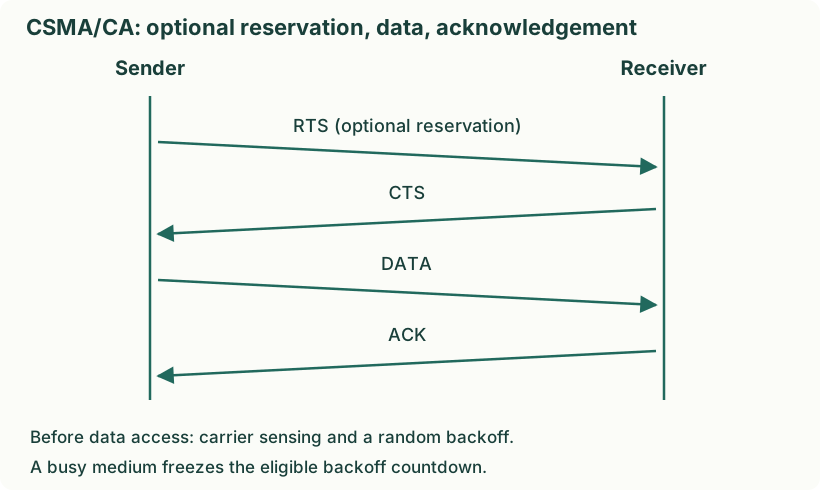
Understand it step by step
- A wireless station senses the medium and follows the required interframe waiting and contention rules.
- A random backoff counter counts down in eligible idle slots and freezes while the medium is busy. It resumes when permitted; it is not continuously counted through someone else’s transmission.
- When its counter reaches zero, it transmits. A unicast receiver normally sends an ACK after successful reception. Missing ACK triggers retry logic.
- RTS/CTS is an optional reservation exchange. Stations hearing reservation information defer for the indicated duration. It can reduce hidden-terminal data collisions but adds overhead.
- Wireless stations cannot generally rely on Ethernet-style collision detection while transmitting. Collision avoidance does not eliminate all losses or collisions.
| Aspect | CSMA/CD | CSMA/CA |
|---|---|---|
| Main action | Detect and abort a collision during sending | Reduce collision risk before sending |
| Typical teaching context | Shared half-duplex wired Ethernet | Wi-Fi contention access |
| Mechanisms | Carrier sensing, detection/jam, backoff | Carrier sensing, random backoff, ACK; optional RTS/CTS |
Yaad rakho: CD = detect during; CA = avoid before.
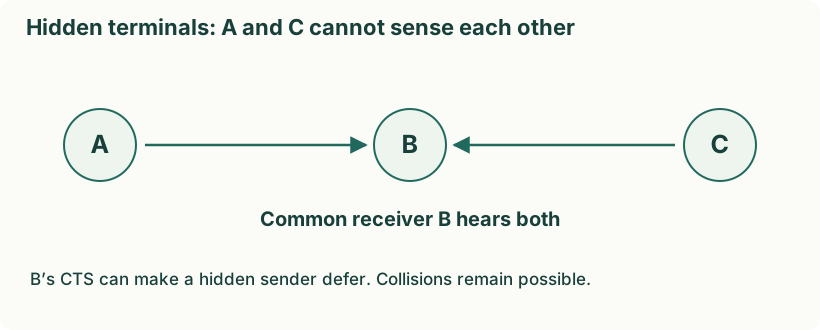
Definition. Hidden terminals are stations that cannot sense each other but whose transmissions can interfere at a common receiver.
Simple meaning. A aur C ek dusre ko nahi sunte, par dono B ko bhej rahe hain.
Understand it step by step
- Suppose A and C are outside each other’s sensing range, but B can receive both.
- A senses no signal from C and may transmit; C may make the same decision. Their frames can collide at B.
- With optional RTS/CTS, A first sends a short RTS to B. B replies CTS, which C can hear. C defers for the reservation duration.
- RTS frames can themselves collide and wireless conditions still matter. Describe RTS/CTS as mitigation, not an absolute guarantee.
A and C may both reach B but be unable to sense one another. Simultaneous transmissions can then collide at B. A short RTS followed by B’s CTS announces a reservation; a station hearing the CTS defers, reducing the risk of a long data-frame collision.
Yaad rakho: Hidden: senders invisible to each other, receiver common.
CSMA/CA flow diagram
Frame ready → sense medium
Busy? yes → defer until eligible idle interval
          ↓
Choose a random backoff → count down eligible idle slots
Medium becomes busy? → freeze counter; resume after required idle wait
          ↓ counter reaches zero
Optional RTS → CTS received? no → retry/back off
          ↓ yes (or RTS/CTS not used)
Send DATA → ACK received? yes → success
                        no → retry/back off or fail at retry limit
A station hearing a duration reservation updates its network allocation vector and defers. RTS/CTS is optional; loss of CTS or ACK triggers recovery but does not by itself prove a collision, because channel errors can also cause loss.