Computer Networks · TEE · papers
Q5(a) · Pure versus slotted ALOHA
2025-02-19 · 2023-24 / 2024-25
Actual paper; 100 marks attempted. Current-syllabus alignment is stated per question.
Q5(a). Define random Access. Differentiate between pure ALOHA & slotted ALOHA in terms of the following performance factors. (i) Throughput (ii) Vulnerable time (iii) Efficiency (iv) Time synchronization. [10 marks]
Answer
Definition. Pure ALOHA is a random-access protocol in which a station transmits whenever a frame is ready and retransmits after a random delay if the transmission is unsuccessful.
Simple meaning. Frame ready → bhej do. Collision hua → random wait karke retry.
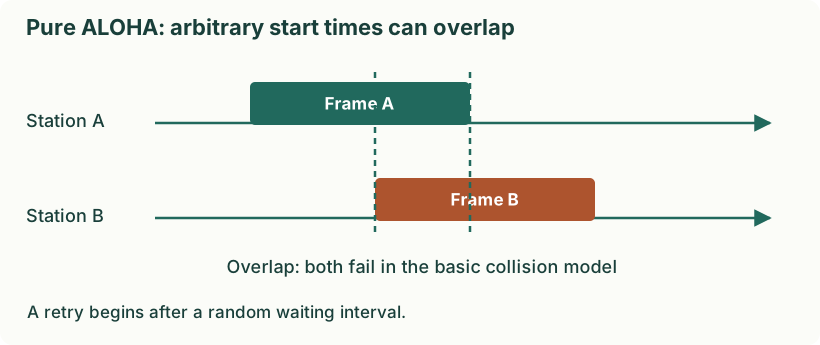
Understand it step by step
- Several stations share the same channel. Pure ALOHA does not first check whether the channel is idle.
- A station transmits immediately. In the basic collision-channel model, any overlapping frame makes the involved frames unsuccessful.
- An acknowledgement indicates successful reception. If it is not received before timeout, the station treats the attempt as unsuccessful. An absent ACK alone cannot distinguish a collision from another loss.
- The station waits a random backoff time and retries. If every station used the same fixed delay, they could collide again together.
In Pure ALOHA, a station transmits a ready frame without carrier sensing. If a successful acknowledgement is not received, it waits for a random interval and retransmits. Overlapping transmissions cause collisions in the basic model. Its maximum normalized throughput is 1/(2e) ≈ 18.4%, so it is inefficient at high offered load.
Yaad rakho: Pure = kisi bhi time start; retry ka wait random.
Definition. The vulnerable period is the interval of start times of other frames that would cause a collision with a chosen frame.
Simple meaning. Apne frame se ek frame-time pehle start hua frame bhi takra sakta hai, aur baad mein bhi.
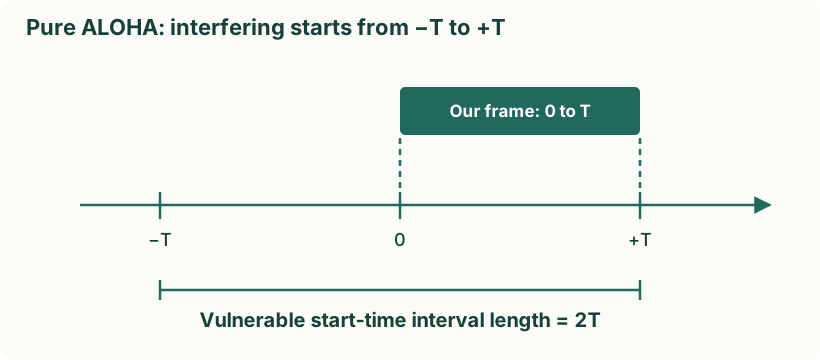
Understand it step by step
- Let your frame start at time 0 and finish at T. All frames have the same transmission duration T.
- Another frame starting between −T and 0 is still being transmitted when your frame begins.
- Another frame starting between 0 and T begins before your frame ends.
- Therefore interfering start times occupy an interval of length 2T. Exact boundary contact is treated as non-overlap in this idealized timing model.
A frame lasting T can collide with an equal-length frame that began less than T earlier, or one that begins less than T later. The two intervals together have length T+T=2T.
Yaad rakho: Pure: before T + after T = 2T.
Definition. Slotted ALOHA is a random-access protocol that divides time into slots of one frame duration and permits transmissions only at the beginning of a slot.
Simple meaning. Frame ready hai tab bhi next slot ki start-line ka wait karo.
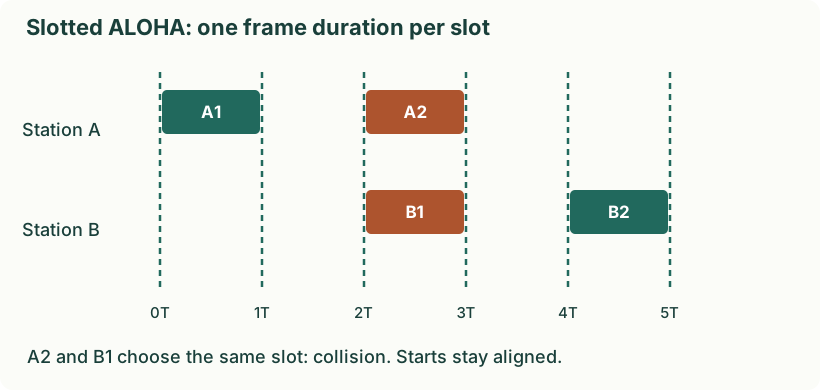
Understand it step by step
- All stations agree on slot boundaries; time synchronization is required.
- A station with a frame waits for a slot boundary before starting. A slot can be idle, successful or a collision.
- Exactly one station transmitting in a slot produces success in the ideal model. Two or more simultaneous attempts collide.
- Frames cannot partially overlap adjacent slots under the assumptions. The vulnerable interval is T instead of 2T. Randomized retries are still needed.
| Feature | Pure | Slotted |
|---|---|---|
| Start time | Any time | Slot boundary only |
| Synchronization | No common slots required | Required |
| Vulnerable period | 2T | T |
| Maximum S | 1/(2e) ≈ 0.184 | 1/e ≈ 0.368 |
| G at maximum | 0.5 | 1 |
Yaad rakho: Slotted = aligned starts; collision risk half-window, not zero.