Computer Networks · TEE · papers
Q7(a) · Guided versus unguided media
2025-02-19 · 2023-24 / 2024-25
Actual paper; 100 marks attempted. Current-syllabus alignment is stated per question.
Q7(a). Compare guided and unguided transmission media in terms of their working principles, key characteristics, and common applications. [5 marks]
Answer
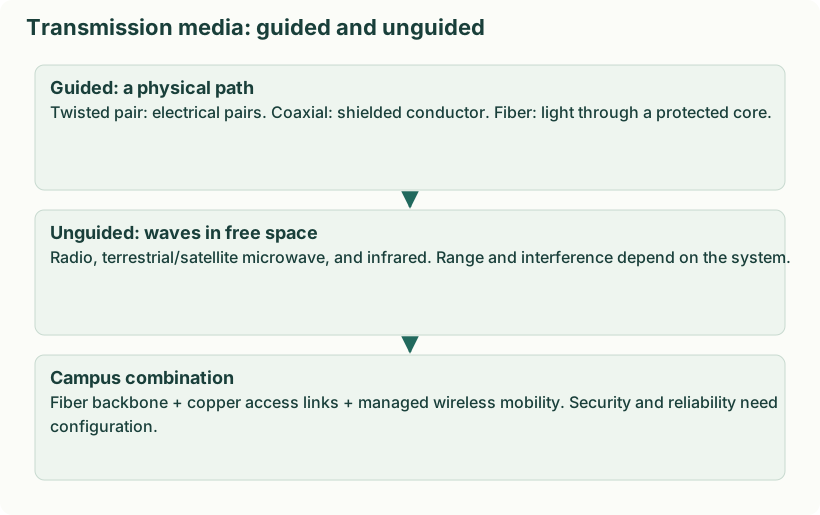
Guided media constrain signals to a physical path: twisted pair, coaxial cable and optical fiber. Unguided media carry electromagnetic waves through free space: radio, microwave and infrared. Wireless bandwidth and reach depend on frequency, power, antenna, obstacles and regulations; media names alone do not fix a speed.
| Medium | Two key characteristics | Limitations / use |
|---|---|---|
| Twisted pair | Electrical signal; pairs twisted to reduce interference | Low-cost LAN access; distance/noise limits depend on category and design |
| Coaxial cable | Shielded central conductor; greater shielding than basic unshielded pair | Bulkier; cable broadband and legacy shared LANs |
| Optical fiber | Light in glass/plastic; high capacity with immunity to electromagnetic interference | Transceivers and careful splicing/bend control needed; backbone links |
| Radio waves | Wireless propagation; many bands support broad/non-line-of-sight coverage | Interference, shared spectrum and security configuration matter; Wi-Fi/mobile |
| Terrestrial microwave | Directional antennas; typically line of sight | Alignment and obstructions matter; point-to-point backhaul |
| Satellite microwave | Wide coverage through relay in space | Cost and latency depend strongly on orbit/system; remote connectivity |
| Infrared | Short-range light; usually blocked by walls | Limited coverage; short-range indoor/remote-control links |
Yaad rakho: Guided = cable path; unguided = free-space waves.
Transmission media are classified into guided media (twisted pair, coaxial cable, optical fiber) and unguided media (radio, microwave, infrared).
Optical fiber carries data as light in a core surrounded by cladding. It is a guided medium. Single-mode fiber supports one main propagation mode and is used for long/high-capacity links; multimode supports multiple modes and is often used over shorter distances.
| Advantages | Disadvantages / design costs |
|---|---|
| High data capacity and low attenuation over suitable links | Optical transceivers, connectors and splicing add cost/skill requirements |
| Immune to electromagnetic interference; no electrical crosstalk | Tight bends, dirty connectors and poor installation increase loss |
| Electrical isolation between buildings | Fiber is mechanically sensitive and requires appropriate protection |
| Harder to tap casually than an unprotected radio channel | It is not automatically confidential; encryption/access control remain necessary |
Yaad rakho: Fiber light carry karta hai; immunity means no EMI, not no security risk.
Two guided media: advantages and disadvantages
| Medium / working principle | Advantages | Disadvantages |
|---|---|---|
| Twisted pair: voltage signals travel on two insulated copper conductors twisted together | Low purchase/installation cost; flexible and easy to terminate for local access | More susceptible to electromagnetic interference than fiber; distance and capacity are limited by cable category and signalling design |
| Optical fiber: light pulses travel through a core guided by its refractive-index structure | High capacity and long reach; immune to electromagnetic interference | Optical equipment and splicing can cost more; tight bends, damage and dirty connectors degrade the link |
These comparisons describe typical engineering tradeoffs, not a guarantee that every fiber installation is faster or more expensive than every copper installation.