Computer Networks · TEE · papers
Q7(c) · ARP
2025-12-05 · 2022-23
Actual paper; 100 marks attempted. Current-syllabus alignment is stated per question.
Q7(c). Explain the method of Address Resolution protocol. [5 marks]
Answer
Definition. Address Resolution Protocol (ARP) resolves a known IPv4 address to a link-layer hardware address on the local network.
Simple meaning. IP pata hai; local delivery ke liye MAC chahiye.
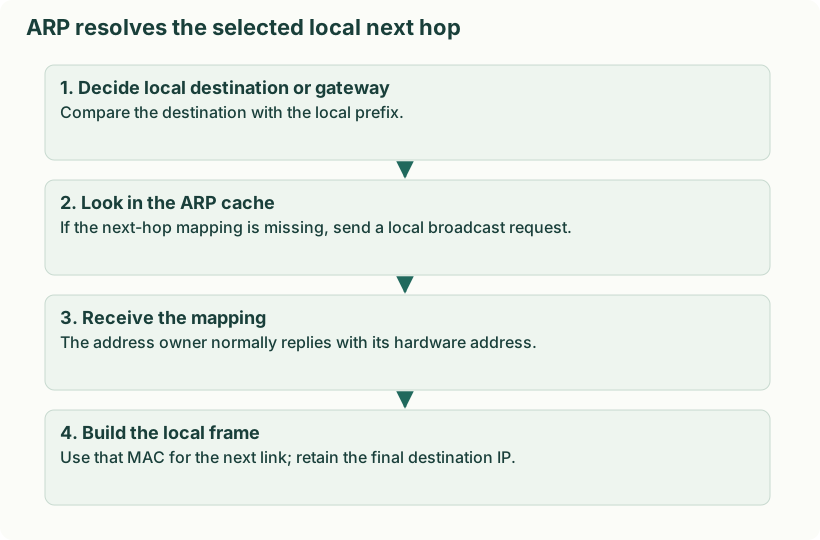
Diagram: ARP resolves the selected local next hop. Labels: ARP resolves the selected local next hop | ARP resolves the selected local next hop | 1. Decide local destination or gateway | Compare the destination with the local prefix. | 2. Look in the ARP cache | If the next-hop mapping is missing, send a local broadcast request. | 3. Receive the mapping | The address owner normally replies with its hardware address. | 4. Build the local frame | Use that MAC for the next link; retain the final destination IP.
Understand it step by step
- First determine whether the destination is on the local subnet. If local, the next hop is the destination itself. If remote, the next hop is a router such as the default gateway.
- Check the ARP cache. If the next-hop mapping is absent, broadcast an ARP request on the local link.
- The owner of the requested IPv4 address normally replies with its hardware address. The sender caches the mapping and constructs its data frame.
- Routers do not normally forward a host’s ARP broadcast across networks. ARP resolves the next hop, not the MAC of a remote Internet server.
ARP maps a known local next-hop IPv4 address to a hardware address. A sender broadcasts a request when the mapping is missing; the address owner replies, and the mapping is cached. For a remote IP destination, the sender resolves its gateway’s local MAC address, then forwards the packet toward that gateway.
Yaad rakho: Remote packet ka next-hop MAC gateway ka hota hai.