Computer Networks · TEE · papers
Q7(d) · SMTP and SNMP
2025-12-05 · 2022-23
Actual paper; 100 marks attempted. Current-syllabus alignment is stated per question.
Q7(d). What are the features of SMTP and SNMP protocol. [5 marks]
Answer
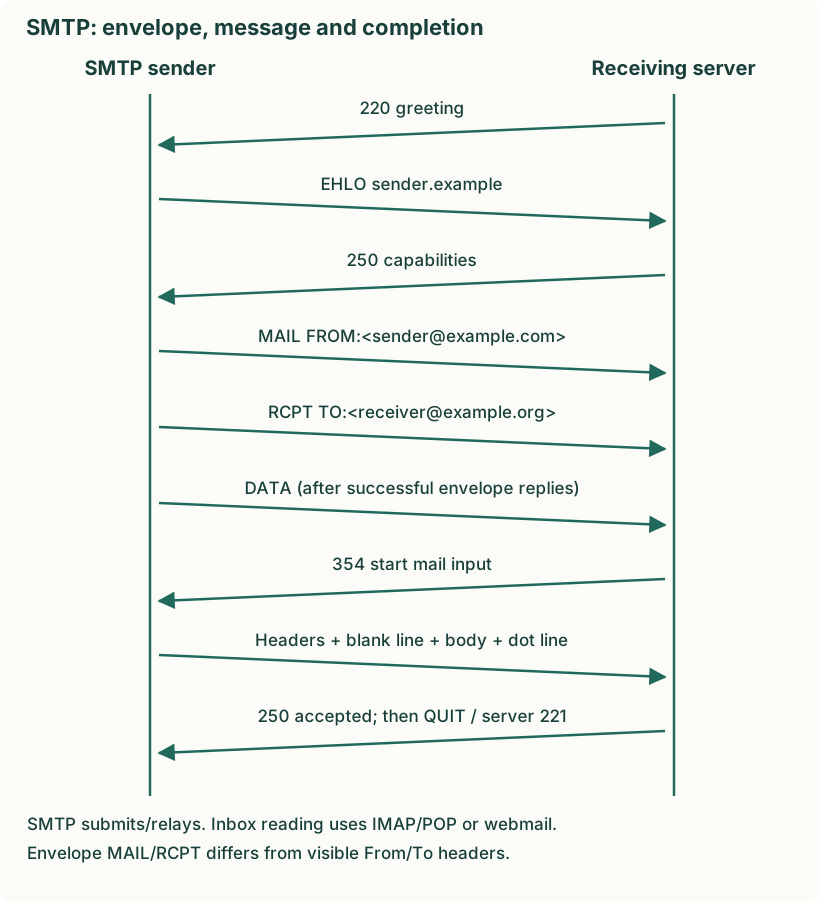
Simple Mail Transfer Protocol (SMTP) transfers email from a sending client/server to a receiving mail server using a reliable transport, normally TCP. It is a push/store-and-forward transfer protocol. User agents compose/read mail; mail-transfer agents relay it, consulting DNS MX records to find recipient-domain mail servers.
| Phase | Typical exchange | Purpose |
|---|---|---|
| Connection and greeting | Server 220; client EHLO (HELO for basic SMTP); server 250 capabilities | Identify peers and learn supported extensions |
| Envelope transfer | MAIL FROM:<sender>; RCPT TO:<recipient>; 250 replies | Declare return path and one or more delivery recipients |
| Message transfer | DATA; server 354; headers + blank line + body; single dot line; server 250 | Transmit the message after server permission; completion reply accepts responsibility |
| Termination | QUIT; server 221 | Close the SMTP session cleanly |
Message flow and important details
- The sender’s user agent submits mail to its configured submission service. Server-to-server SMTP relay commonly uses TCP port 25; message submission commonly uses 587, often with authentication and TLS policy.
- The sending server resolves the recipient domain’s MX records, connects to an appropriate mail server and carries out the SMTP exchange.
- MAIL FROM and RCPT TO are the envelope; visible From/To headers inside DATA are message content and can differ. Multiple RCPT TO commands can name several recipients.
- A line containing only a dot ends DATA. A content line beginning with a dot is dot-stuffed for transparency and unstuffed by the receiver.
- A temporary 4xx failure can lead the sending server to queue and retry; a permanent 5xx failure normally rejects that operation. One successful handoff is not proof that a human read the message.
- The recipient reads stored mail using an access protocol such as IMAP/POP3 or webmail. SMTP is not the mailbox-retrieval protocol.
Yaad rakho: SMTP send/relay; inbox read IMAP/POP/webmail.
SNMP is a network-management protocol (manager/agent, management information, requests/responses and notifications). It is not named in the current syllabus. This question’s combined 5 marks cannot be split into SMTP and SNMP without a printed allocation.