Computer Networks · TEE · papers
Q1B · OSI and TCP/IP comparison
Final · 5 December 2025
TEE · Actual TEE paper · all questions · current syllabus 702AI0C023
Actual PYQ · Q1B. Compare and contrast the TCP/IP model with the OSI model on any five points. [5 marks]
Answer
The TCP/IP model describes the Internet protocol suite in four layers. Many teaching books split the link layer into data link and physical, making a five-layer teaching model; identify the convention before drawing.
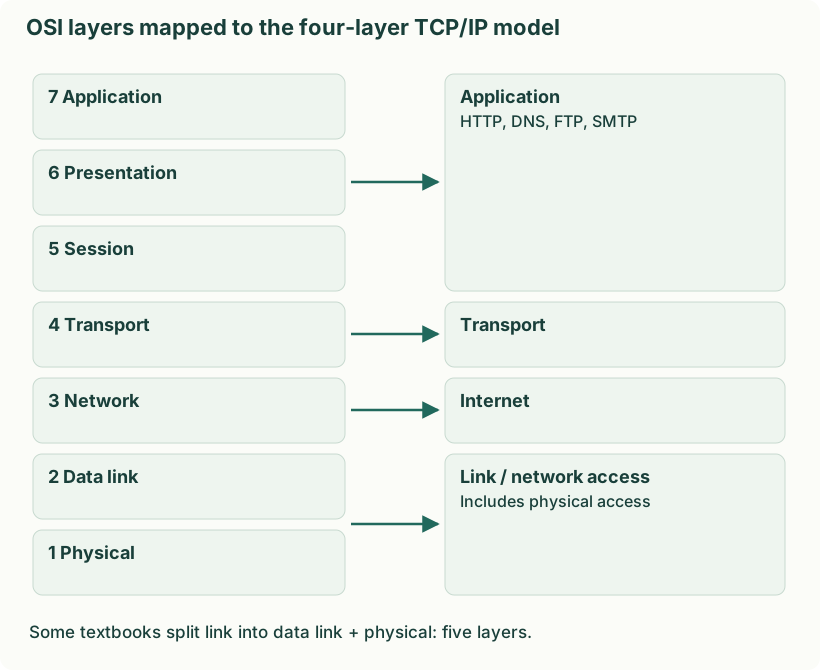
Diagram: OSI layers mapped to the four-layer TCP/IP model. Labels: OSI layers mapped to the four-layer TCP/IP model | OSI layers mapped to the four-layer TCP/IP model | 7 Application | 6 Presentation | 5 Session | 4 Transport | 3 Network | 2 Data link | 1 Physical | Application | HTTP, DNS, FTP, SMTP | Transport | Internet | Link / network access | Includes physical access | Some textbooks split link into data link + physical: five layers.
| TCP/IP layer | Function | Examples |
|---|---|---|
| Application | Defines application message formats and exchanges for Web access, naming, email and file transfer; includes presentation/session functions as needed | HTTP, DNS, SMTP, FTP |
| Transport | End-to-end process communication | TCP, UDP, SCTP |
| Internet | IP addressing, routing and best-effort datagrams | IPv4/IPv6 |
| Link/network access | Local delivery and physical access | Ethernet/Wi-Fi and their medium |
| Point | OSI | TCP/IP |
|---|---|---|
| Layer count | Seven | Four here; five-layer teaching variant splits link |
| Upper functions | Application, presentation, session separated | Grouped under application |
| Lower functions | Data link and physical separated | Grouped under link/network access |
| Purpose | General reference architecture | Architecture of deployed Internet protocol family |
| Network service | Reference model can describe different services | Internet layer uses connectionless IP |
| Transport | Conceptual transport service | TCP reliable byte stream; UDP datagrams; SCTP messages |
Source: Final · 5 December 2025, original question paper page 1. Original marks retained; solution independently authored.