Computer Networks · TEE · papers
Q2B · Choose a switching technique
Final · 5 December 2025
TEE · Actual TEE paper · all questions · current syllabus 702AI0C023
Actual PYQ · Q2B. A company wants to set up a network for smooth data transfer between its offices. Based on your understanding, which switching technique—circuit, packet, or message—would you recommend? Explain how each works and compare their pros, cons, and best use cases to support your choice. [10 marks]
Answer
Circuit switching
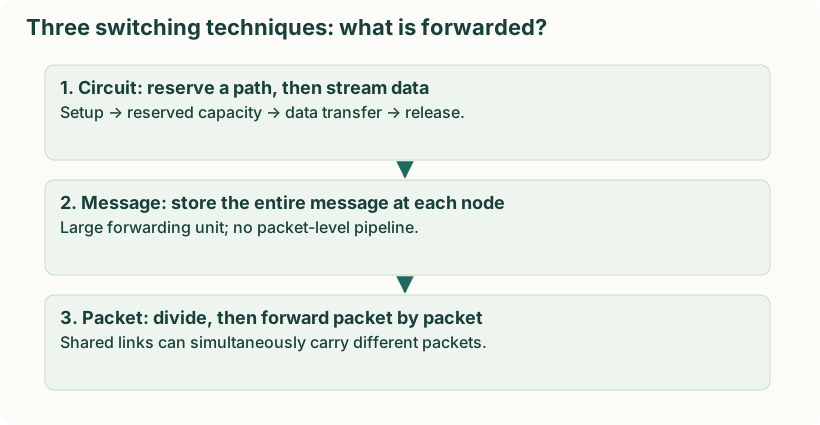
A setup phase reserves a circuit through intermediate switches. Data then streams through the established path until release. It offers predictable reserved service and low per-unit forwarding overhead, but setup takes time and idle periods waste reserved capacity. A traditional dedicated voice circuit is an appropriate illustration.
Message switching
Each intermediate node receives and stores the entire message before forwarding it. Links can be shared and no end-to-end circuit is required, but large messages need buffers and cause substantial store-and-forward delay. It illustrates delay-tolerant whole-message delivery, rather than an efficient choice for interactive office traffic.
Packet switching
A message is segmented into packets, allowing shared links and pipelined forwarding. This suits bursty data and supports flexible routing. Costs include packet headers, variable queueing delay, potential packet loss and possible reordering in datagram networks.
| Aspect | Circuit switching | Message switching | Packet switching |
|---|---|---|---|
| Unit handled | Continuous stream on established circuit | Whole message | Small packets |
| Resource use | Capacity reserved along a circuit | Shared; message stored at each intermediate node | Shared; each packet stored/forwarded in this model |
| Setup | Required before data transfer | No circuit setup required | Datagram: no connection setup; virtual circuit: setup |
| Delay | Setup delay, then relatively predictable service | Large store-and-forward delay for long messages | Variable delay; packet pipeline can reduce completion time |
| Main limitation | Reserved capacity can be idle | Large buffers; unsuitable for tight delay needs | Headers, possible queueing/loss; datagrams may reorder |
Recommendation
For ordinary office file, web and collaboration traffic, choose packet switching, with adequate capacity and traffic management. Its statistical sharing serves bursty sources efficiently. If strict deterministic service is required, state that requirement and discuss additional service engineering rather than promising that every packet network guarantees timing.
Source: Final · 5 December 2025, original question paper page 2. Original marks retained; solution independently authored.