Computer Networks · TEE · papers
Q5A · Selective Repeat with three bits
Final · 5 December 2025
TEE · Actual TEE paper · all questions · current syllabus 702AI0C023
Actual PYQ · Q5A. Apply the principles of the Selective Repeat ARQ Sliding Window Protocol to determine the maximum permissible sender and receiver window sizes for a frame sequence number field of 3 bits, and explain with the help of a diagram how frames are transmitted, acknowledged, and buffered at both the sender and receiver ends. Justify why this window size is chosen, and analyze how incorrect window sizing can lead to frame misordering or acknowledgment ambiguity. [10 marks]
Answer
Selective Repeat (SR) ARQ accepts and buffers valid out-of-order frames inside the receiver window, acknowledges them individually and retransmits only missing/timed-out frames. In this answer ACK i means “frame i received”, unlike the next-expected cumulative ACK convention used for GBN.
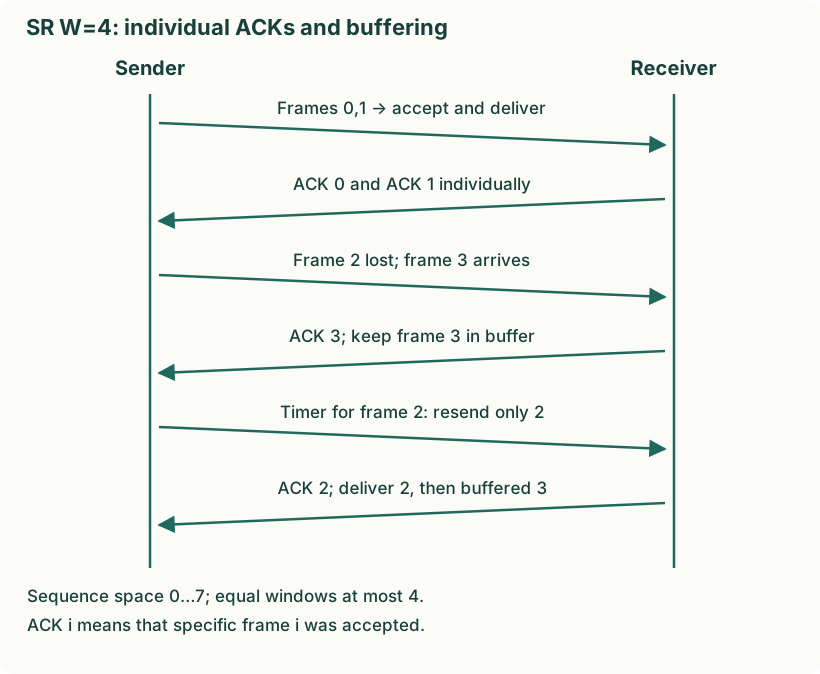
Diagram: SR W=4: individual ACKs and buffering. Labels: SR W=4: individual ACKs and buffering | SR W=4: individual ACKs and buffering | Sender | Receiver | Frames 0,1 → accept and deliver | ACK 0 and ACK 1 individually | Frame 2 lost; frame 3 arrives | ACK 3; keep frame 3 in buffer | Timer for frame 2: resend only 2 | ACK 2; deliver 2, then buffered 3 | Sequence space 0…7; equal windows at most 4. | ACK i means that specific frame i was accepted.
- For m=3 there are eight sequence numbers, 0…7. With equal sender and receiver windows, maximum W=23−1=4. Both windows begin at 0 and span 0…3.
- Sender sends 0,1,2,3. Receiver accepts 0 and 1, delivers them and advances its left edge to 2. Frame 2 is lost; frame 3 is stored and ACK 3 is sent.
- Although 3 is acknowledged, the sender’s base cannot jump over missing 2. A timer for 2 expires; only frame 2 is retransmitted.
- When 2 arrives, the receiver can deliver 2 and the buffered 3 in order, moving its window forward. Individual ACKs let the sender release the relevant stored copies.
- Why half the space: with an incorrectly chosen W=5 in an eight-number space, receiving old 0…4 moves the receive window to {5,6,7,0,1}. If ACKs are lost, retransmitted old 0 or 1 could fall in the new window and be mistaken for new data. W=4 prevents these two consecutive windows from overlapping.
- A repeated old frame can be acknowledged again without delivering it twice. SR needs more receiver storage and per-frame tracking than GBN.
 LaTeX:
W_s=W_r\le 2^{m-1}Source: Final · 5 December 2025, original question paper page 2. Original marks retained; solution independently authored.