Computer Networks · TEE · papers
Q6C · Open-loop and closed-loop control
Final · 5 December 2025
TEE · Actual TEE paper · all questions · current syllabus 702AI0C023
Actual PYQ · Q6C. Explain open-loop and closed-loop congestion control policy in transmission control protocol. Describe any two policies from each type. [10 marks]
Answer
Congestion occurs when offered traffic overloads network resources such as link capacity, router buffers or processing. Queueing delay grows, packets may be dropped, and excessive retransmission can make the overload worse. Flow control protects a receiver; congestion control protects the network.
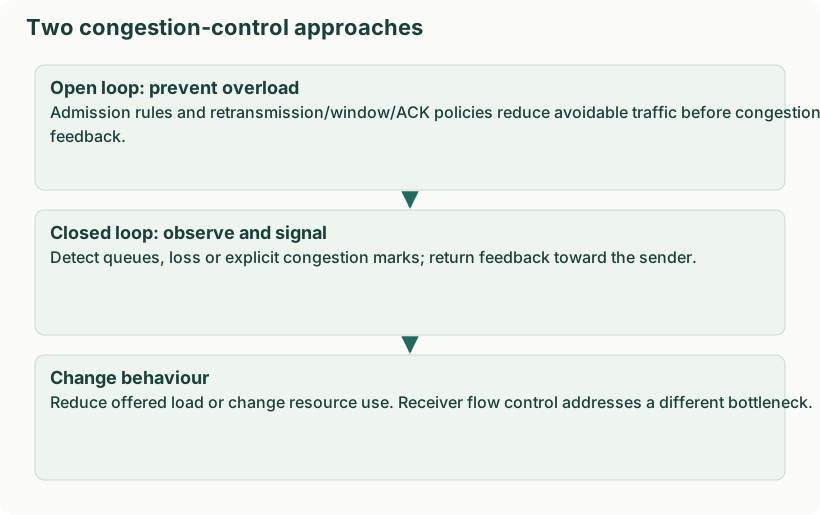
| Approach | Policy / mechanism | How it helps |
|---|---|---|
| Open loop: prevent congestion without runtime congestion feedback | Retransmission policy | Carefully chosen timers/selective retransmission avoid needless extra traffic |
| Open loop | Window policy | Limit outstanding data and avoid excessive retransmission after loss |
| Open loop | Acknowledgement policy | Avoid unnecessarily frequent ACK traffic while retaining correct recovery |
| Open loop | Admission policy | Refuse new load when reserved capacity is insufficient |
| Closed loop: measure and react to congestion | Backpressure | A congested node tells upstream nodes to reduce/stop sending, possibly propagating hop by hop |
| Closed loop | Choke/control signalling | A congested node sends explicit feedback to the source |
| Closed loop | Implicit signalling | A sender infers congestion from loss/delay and changes its sending behaviour |
| Closed loop | Explicit marking | Network marks congestion (for example ECN); endpoints react to returned information |
For an answer asking for two of each: explain retransmission and admission policies under open loop, then backpressure and explicit signalling under closed loop, with the mechanism and its effect. These are general congestion-control classifications used in the course; they are not all mandatory algorithms implemented inside TCP. TCP commonly uses end-to-end feedback such as loss or ECN.
Source: Final · 5 December 2025, original question paper page 2. Original marks retained; solution independently authored.