Computer Networks · TEE · papers
Q7A · Dijkstra with all intermediate steps
Final · 5 December 2025
TEE · Actual TEE paper · all questions · current syllabus 702AI0C023
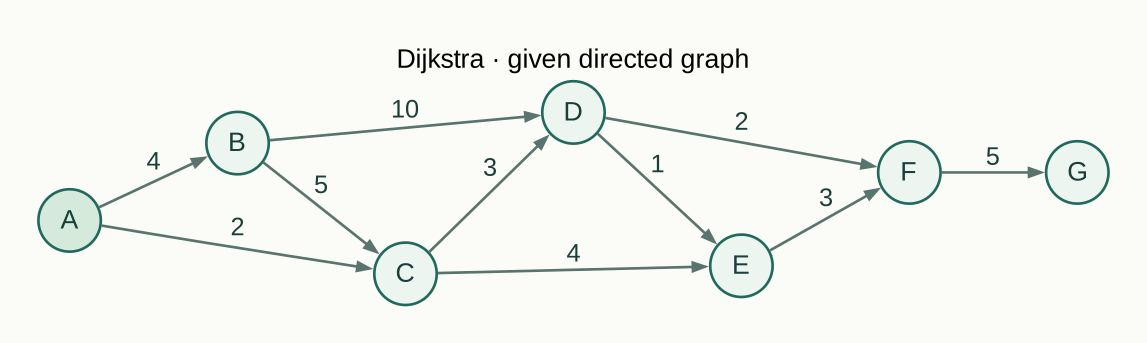
Actual PYQ · Q7A. Consider a network topology consisting of nodes A, B, C, D, E, F, and G. The directed edges between these nodes and their corresponding positive weights are given in the table below. Using Dijkstra’s Algorithm: (i) Determine the shortest path from source A to destination G. (ii) Compute the shortest distance. (iii) Show all intermediate steps, including initialization and selection of the minimum-distance node for each iteration. (iv) Illustrate the original topology and final shortest path with edge distances. Directed edges: A→B=4, A→C=2, B→C=5, B→D=10, C→D=3, C→E=4, D→E=1, D→F=2, E→F=3, F→G=5. [10 marks]
Answer
Given
| Edge | Cost |
|---|---|
| A→B | 4 |
| A→C | 2 |
| B→C | 5 |
| B→D | 10 |
| C→D | 3 |
| C→E | 4 |
| D→E | 1 |
| D→F | 2 |
| E→F | 3 |
| F→G | 5 |
Source=A; target=G. Edges are directed; do not add reverse edges.
To find
The path A to G, its total cost and intermediate work.
Formula and why
 LaTeX:
d[v]\leftarrow\min(d[v],d[u]+w(u,v))Use Dijkstra because all weights are nonnegative. Select the smallest unsettled total distance, not the cheapest isolated edge.
Step-by-step solution
Step 1. Initialize
d[A]=0; every other distance=∞. No predecessors are known.
| Vertex | Distance from A | Predecessor | State |
|---|---|---|---|
| A | 0 | — | Tentative |
| B | ∞ | — | Tentative |
| C | ∞ | — | Tentative |
| D | ∞ | — | Tentative |
| E | ∞ | — | Tentative |
| F | ∞ | — | Tentative |
| G | ∞ | — | Tentative |
Step 2. Settle A at distance 0
Unsettled candidates before selection: A=0, B=∞, C=∞, D=∞, E=∞, F=∞, G=∞. Select the minimum; ties use alphabetical order.
| Edge | Old distance | Candidate | Decision |
|---|---|---|---|
| A→B | ∞ | 0+(4)=4 | Improve to 4; predecessor=A |
| A→C | ∞ | 0+(2)=2 | Improve to 2; predecessor=A |
| Vertex | Distance from A | Predecessor | State |
|---|---|---|---|
| A | 0 | — | Settled |
| B | 4 | A | Tentative |
| C | 2 | A | Tentative |
| D | ∞ | — | Tentative |
| E | ∞ | — | Tentative |
| F | ∞ | — | Tentative |
| G | ∞ | — | Tentative |
Step 3. Settle C at distance 2
Unsettled candidates before selection: B=4, C=2, D=∞, E=∞, F=∞, G=∞. Select the minimum; ties use alphabetical order.
| Edge | Old distance | Candidate | Decision |
|---|---|---|---|
| C→D | ∞ | 2+(3)=5 | Improve to 5; predecessor=C |
| C→E | ∞ | 2+(4)=6 | Improve to 6; predecessor=C |
| Vertex | Distance from A | Predecessor | State |
|---|---|---|---|
| A | 0 | — | Settled |
| B | 4 | A | Tentative |
| C | 2 | A | Settled |
| D | 5 | C | Tentative |
| E | 6 | C | Tentative |
| F | ∞ | — | Tentative |
| G | ∞ | — | Tentative |
Step 4. Settle B at distance 4
Unsettled candidates before selection: B=4, D=5, E=6, F=∞, G=∞. Select the minimum; ties use alphabetical order.
| Edge | Old distance | Candidate | Decision |
|---|---|---|---|
| B→C | 2 | 4+(5)=9 | Already settled; retain |
| B→D | 5 | 4+(10)=14 | Retain 5 |
| Vertex | Distance from A | Predecessor | State |
|---|---|---|---|
| A | 0 | — | Settled |
| B | 4 | A | Settled |
| C | 2 | A | Settled |
| D | 5 | C | Tentative |
| E | 6 | C | Tentative |
| F | ∞ | — | Tentative |
| G | ∞ | — | Tentative |
Step 5. Settle D at distance 5
Unsettled candidates before selection: D=5, E=6, F=∞, G=∞. Select the minimum; ties use alphabetical order.
| Edge | Old distance | Candidate | Decision |
|---|---|---|---|
| D→E | 6 | 5+(1)=6 | Retain 6 (equal cost) |
| D→F | ∞ | 5+(2)=7 | Improve to 7; predecessor=D |
| Vertex | Distance from A | Predecessor | State |
|---|---|---|---|
| A | 0 | — | Settled |
| B | 4 | A | Settled |
| C | 2 | A | Settled |
| D | 5 | C | Settled |
| E | 6 | C | Tentative |
| F | 7 | D | Tentative |
| G | ∞ | — | Tentative |
Step 6. Settle E at distance 6
Unsettled candidates before selection: E=6, F=7, G=∞. Select the minimum; ties use alphabetical order.
| Edge | Old distance | Candidate | Decision |
|---|---|---|---|
| E→F | 7 | 6+(3)=9 | Retain 7 |
| Vertex | Distance from A | Predecessor | State |
|---|---|---|---|
| A | 0 | — | Settled |
| B | 4 | A | Settled |
| C | 2 | A | Settled |
| D | 5 | C | Settled |
| E | 6 | C | Settled |
| F | 7 | D | Tentative |
| G | ∞ | — | Tentative |
Step 7. Settle F at distance 7
Unsettled candidates before selection: F=7, G=∞. Select the minimum; ties use alphabetical order.
| Edge | Old distance | Candidate | Decision |
|---|---|---|---|
| F→G | ∞ | 7+(5)=12 | Improve to 12; predecessor=F |
| Vertex | Distance from A | Predecessor | State |
|---|---|---|---|
| A | 0 | — | Settled |
| B | 4 | A | Settled |
| C | 2 | A | Settled |
| D | 5 | C | Settled |
| E | 6 | C | Settled |
| F | 7 | D | Settled |
| G | 12 | F | Tentative |
Step 8. Settle G at distance 12
Unsettled candidates before selection: G=12. Select the minimum; ties use alphabetical order.
No outgoing edges to relax.
| Vertex | Distance from A | Predecessor | State |
|---|---|---|---|
| A | 0 | — | Settled |
| B | 4 | A | Settled |
| C | 2 | A | Settled |
| D | 5 | C | Settled |
| E | 6 | C | Settled |
| F | 7 | D | Settled |
| G | 12 | F | Settled |
Step 9. Recover the path
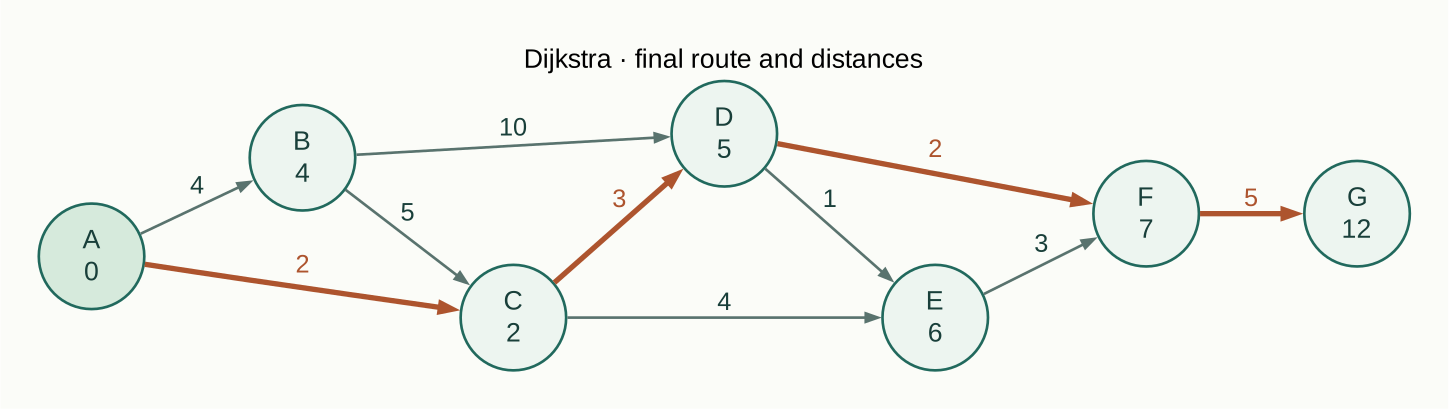
Trace backwards: G ← F ← D ← C ← A. Reverse it: A → C → D → F → G.
Edge sum: 2 + 3 + 2 + 5 = 12.
Final answer: A → C → D → F → G; cost=12.
Source: Final · 5 December 2025, original question paper page 3. Original marks retained; solution independently authored.