Computer Networks · TEE · papers
Q1A · Client-server and peer-to-peer
Re-exam · 4 February 2026
TEE · Actual TEE paper · all questions · current syllabus 702AI0C023
Actual PYQ · Q1A. An organization plans to deploy an online collaboration platform. Apply the concepts of the Client–Server model and the Peer-to-Peer model to explain how each could be implemented in this scenario with respect to performance, scalability, and reliability. [5 marks]
Answer
In a client-server design, users’ clients contact designated service processes. In peer-to-peer (P2P), participating hosts can supply and consume resources. These are application organizations, not different physical cable types.
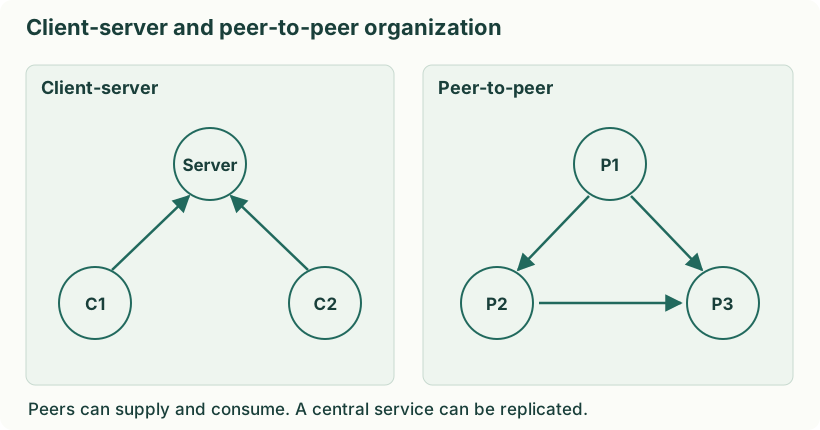
| Point | Client-server | Peer-to-peer |
|---|---|---|
| Roles | Clients request; designated servers provide services | Peers can both request and provide resources |
| Control | Central policies, accounts and backups are easier to coordinate | Control and copies distributed among peers |
| Performance | Predictable with adequate server capacity; server may bottleneck | Resources grow with peers, but peer capacity/availability vary |
| Scalability | Scale servers, replicas, caching and load distribution | More peers can contribute capacity; coordination becomes harder |
| Reliability | One unreplicated server is a failure point; replication helps | Loss of one peer need not stop system if useful replicas remain |
| Security | Central access control and monitoring | Trust and consistent access policy are harder |
| Best fit | Managed collaboration, databases, login services | Distributed content sharing among participating peers |
Apply to the platform
Central servers can authenticate users, maintain the authoritative shared document and control versions. The organization must provision capacity, replicate data and avoid a single server failure. P2P can exchange large files or local edits among peers and distribute load, but needs discovery, conflict resolution, trust and availability strategies. A hybrid can keep account control centralized while distributing selected content.
Source: Re-exam · 4 February 2026, original question paper page 1. Original marks retained; solution independently authored.