Computer Networks · TEE · papers
Q3C · DNS namespace
Re-exam · 4 February 2026
TEE · Actual TEE paper · all questions · current syllabus 702AI0C023
Actual PYQ · Q3C. With the help of a neat diagram, explain the hierarchical structure of the domain namespace in DNS and describe how this structure ensures the uniqueness of domain names across the Internet. [10 marks]
Answer
The Domain Name System (DNS) is a distributed hierarchical naming system. Its namespace is a tree with the root at the top. A complete name is the ordered path of labels from a node back to the root. An absolute name may be written with a trailing dot, for example www.example.com.
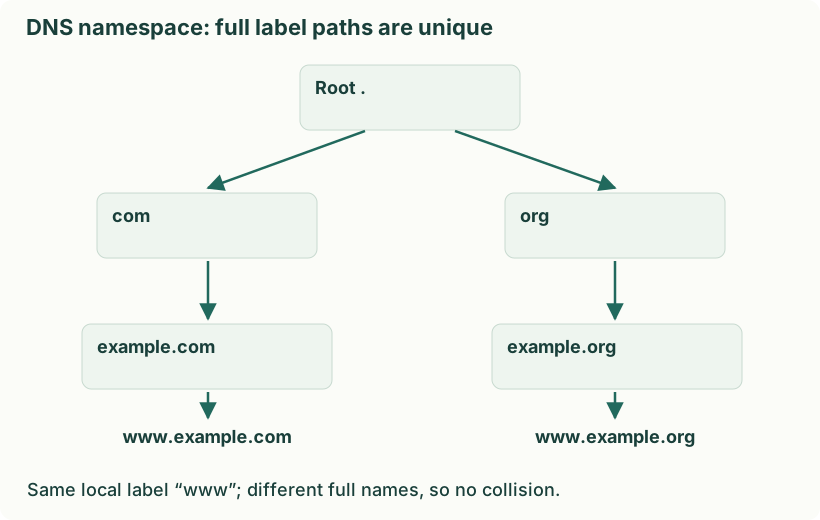
Diagram: DNS namespace: full label paths are unique. Labels: DNS namespace: full label paths are unique | DNS namespace: full label paths are unique | Root . | com | org | example.com | example.org | www.example.com | www.example.org | Same local label “www”; different full names, so no collision.
| Level | Example | Meaning |
|---|---|---|
| Root | . | Top of the namespace |
| Top-level domain (TLD) | com, org, in | A child zone below the root |
| Registered/delegated domain | example.com | Name under a parent such as com |
| Subdomain/host label | www.example.com | A label below example.com; a name may own different record types |
Why names remain unique
- A parent manages the labels immediately beneath it and does not assign the same child label to two different nodes in that parent’s namespace.
- The full sequence of labels identifies the node. The local label www can appear below many domains without conflict: www.example.com and www.example.org are different complete names.
- Administration is delegated: the parent publishes information identifying authoritative servers for a child zone. A domain is a namespace subtree; a zone is the portion administered together, excluding subtrees delegated onward.
- Multiple names may resolve to one IP address, and one name can return several addresses. Uniqueness of names does not imply a one-name/one-IP rule.
Resolution
- A client stub resolver normally asks a recursive resolver for the answer. If a usable cached result exists, the resolver can return it.
- Otherwise the resolver can query a root server, receive a referral to the relevant TLD, then receive a referral to the authoritative server for the domain.
- The authoritative server supplies the requested record or a relevant negative response. The recursive resolver returns the result and may cache it according to TTL.
Source: Re-exam · 4 February 2026, original question paper page 2. Original marks retained; solution independently authored.