Computer Networks · TEE · papers
Q4A · IPv6 packet format
Re-exam · 4 February 2026
TEE · Actual TEE paper · all questions · current syllabus 702AI0C023
Actual PYQ · Q4A. Construct the IPv6 packet format and explain the purpose of each field. [10 marks]
Answer
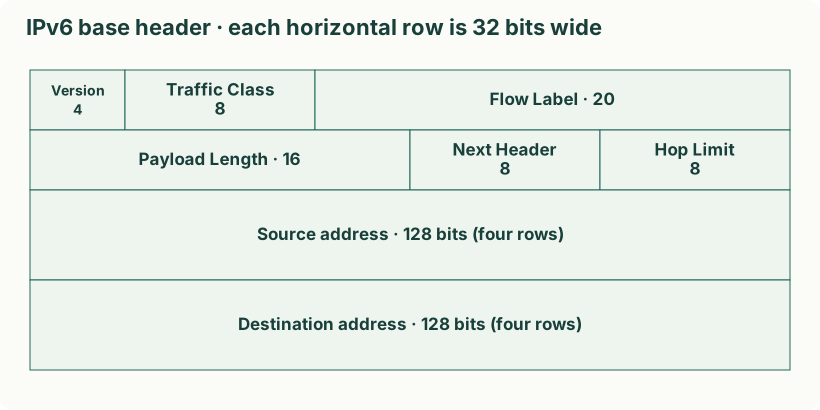
Diagram: IPv6 base header · each horizontal row is 32 bits wide. Labels: IPv6 base header · each horizontal row is 32 bits wide | IPv6 base header · each horizontal row is 32 bits wide | Version | 4 | Traffic Class | 8 | Flow Label · 20 | Payload Length · 16 | Next Header | 8 | Hop Limit | 8 | Source address · 128 bits (four rows) | Destination address · 128 bits (four rows)
| Field | Bits | Purpose |
|---|---|---|
| Version | 4 | Value 6 |
| Traffic Class | 8 | Traffic treatment/congestion-related marking |
| Flow Label | 20 | Identifies a flow for appropriate handling |
| Payload Length | 16 | Bytes after the base header; includes extension headers when present |
| Next Header | 8 | Type of the next extension header or upper-layer protocol |
| Hop Limit | 8 | Decremented on forwarding; limits packet lifetime in hops |
| Source address | 128 | Sending interface address |
| Destination address | 128 | Destination address |
The first two 32-bit rows contain 64 bits and the two addresses contain 256 bits, giving a 320-bit base header. Payload Length excludes these 40 bytes. Next Header can identify an extension header or upper-layer protocol. IPv6 has no base-header checksum; optional information is carried through extension headers.
Source: Re-exam · 4 February 2026, original question paper page 2. Original marks retained; solution independently authored.