Computer Networks · TEE · papers
Q5A · Go-Back-N three cases
Re-exam · 4 February 2026
TEE · Actual TEE paper · all questions · current syllabus 702AI0C023
Actual PYQ · Q5A. Apply the Go-Back-N ARQ Sliding Window Protocol for window size 7 and explain its working in real-time transmission scenarios. Illustrate with diagrams and examples how sender and receiver windows move in (a) normal transmission (no error), (b) lost data frame and (c) lost acknowledgment. Analyze retransmission and window shifting in each case to ensure reliable delivery. [10 marks]
Answer
Go-Back-N (GBN) ARQ pipelines up to W outstanding frames. For m-bit sequence numbers, textbook GBN uses W ≤ 2m−1 and receiver window 1. The receiver accepts only the next in-order frame; out-of-order frames are discarded. ACK k here cumulatively acknowledges all frames before k and means “next expected is k”.
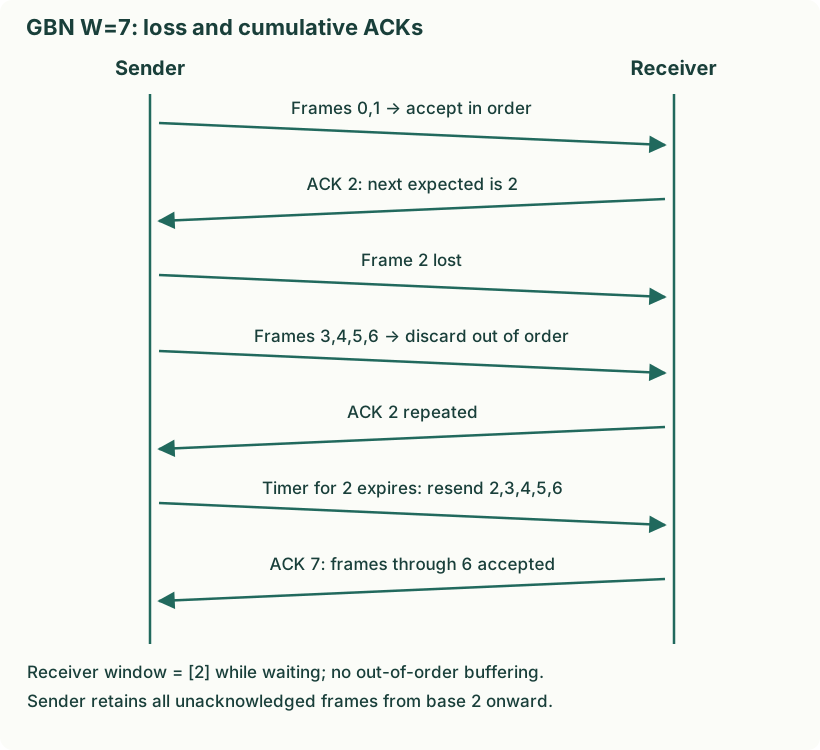
Diagram: GBN W=7: loss and cumulative ACKs. Labels: GBN W=7: loss and cumulative ACKs | GBN W=7: loss and cumulative ACKs | Sender | Receiver | Frames 0,1 → accept in order | ACK 2: next expected is 2 | Frame 2 lost | Frames 3,4,5,6 → discard out of order | ACK 2 repeated | Timer for 2 expires: resend 2,3,4,5,6 | ACK 7: frames through 6 accepted | Receiver window = [2] while waiting; no out-of-order buffering. | Sender retains all unacknowledged frames from base 2 onward.
- For W=7 with m=3, the sequence space is 0…7. Initially the sender can transmit 0…6. It stores every unacknowledged frame; a timer tracks the oldest one.
- Normal: after receiving 0 and 1, cumulative ACK 2 advances the sender base to 2. The sender can fill newly opened window slots.
- Lost data: if frame 2 is lost, frames 3…6 arrive out of order and are discarded. Repeated ACK 2 says frame 2 is still expected. On timeout the sender retransmits all outstanding frames starting at 2, here 2…6.
- Lost ACK: if ACK 2 is lost but ACK 3 arrives, the later cumulative ACK confirms frames 0…2 and avoids unnecessary retransmission. If no later useful ACK arrives before timeout, the sender retransmits from its oldest outstanding frame; the receiver rejects duplicates and sends its current ACK.
- After sequence 7, numbers wrap to 0. The bound W ≤ 7 leaves one sequence value outside the sender’s current window, preventing the all-ACKs-lost ambiguity of a full eight-frame window in the textbook model.
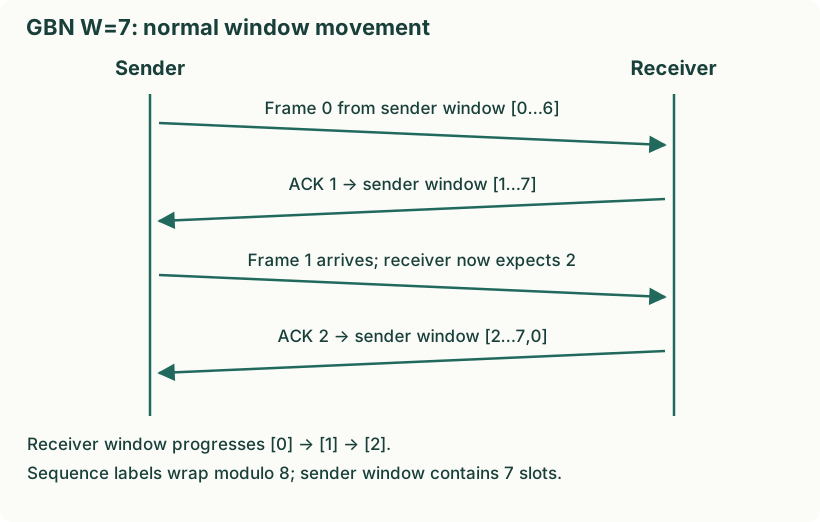
Diagram: GBN W=7: normal window movement. Labels: GBN W=7: normal window movement | GBN W=7: normal window movement | Sender | Receiver | Frame 0 from sender window [0…6] | ACK 1 → sender window [1…7] | Frame 1 arrives; receiver now expects 2 | ACK 2 → sender window [2…7,0] | Receiver window progresses [0] → [1] → [2]. | Sequence labels wrap modulo 8; sender window contains 7 slots.
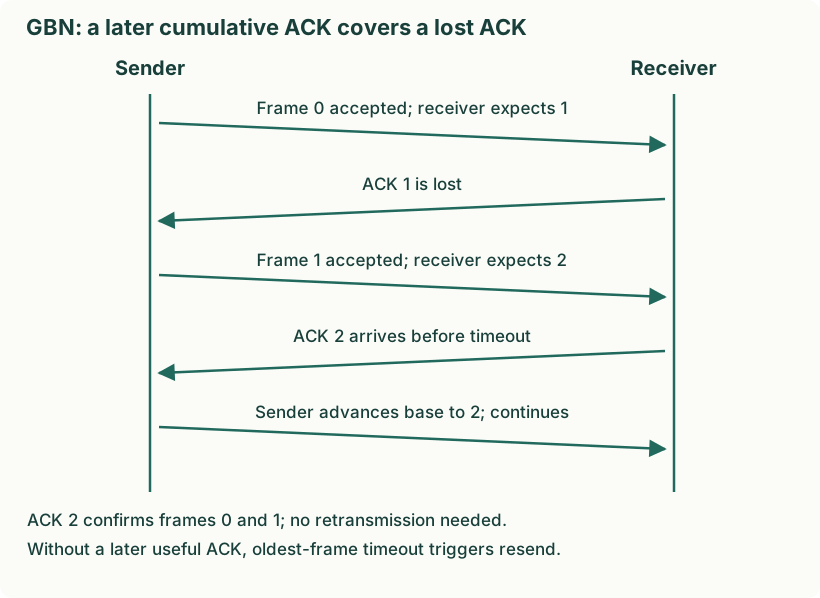
Diagram: GBN: a later cumulative ACK covers a lost ACK. Labels: GBN: a later cumulative ACK covers a lost ACK | GBN: a later cumulative ACK covers a lost ACK | Sender | Receiver | Frame 0 accepted; receiver expects 1 | ACK 1 is lost | Frame 1 accepted; receiver expects 2 | ACK 2 arrives before timeout | Sender advances base to 2; continues | ACK 2 confirms frames 0 and 1; no retransmission needed. | Without a later useful ACK, oldest-frame timeout triggers resend.
Source: Re-exam · 4 February 2026, original question paper page 2. Original marks retained; solution independently authored.