Computer Networks · TEE · practice
Supporting numerical: stop-and-wait utilization
Unit 3 · Flow control and ARQ · optional practice
Optional extension · no matching calculation in the two supplied papers
Optional worked extension. This calculation format was not found in the supplied December 2025 final or February 2026 re-exam. The numbers and practice marks are authored. Study the core concept and actual-paper questions first; this is extra explanation, not a TEE prediction.
Practice question. Derive ideal Stop-and-Wait utilization and the window needed to keep a link busy. [5 practice marks]
Answer
Assume an error-free link, constant data-frame transmission time Tt, one-way propagation Tp, ACK transmission Ta, negligible processing and no queueing. One stop-and-wait cycle takes Tt+2Tp+Ta. Useful data occupies the forward link for Tt of that cycle.
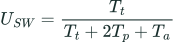 LaTeX:
U_{SW}=\frac{T_t}{T_t+2T_p+T_a} LaTeX:
U_W\approx\min\left(1,\frac{WT_t}{T_t+2T_p+T_a}\right) LaTeX:
W_{\mathrm{required}}=\left\lceil\frac{T_t+2T_p+T_a}{T_t}\right\rceilThese are ideal teaching bounds for equal frames and a sufficiently fast independent ACK path. Loss, ACK scheduling, headers and a limited sequence space reduce actual performance. A calculated window must also satisfy the selected ARQ protocol’s sequence-number bound.