Computer Networks · TEE · practice
Store-and-forward and pipelining
Switching techniques · optional practice
Optional extension · no matching calculation in the two supplied papers
Optional worked extension. This calculation format was not found in the supplied December 2025 final or February 2026 re-exam. The numbers and practice marks are authored. Study the core concept and actual-paper questions first; this is extra explanation, not a TEE prediction.
Definition. Store-and-forward requires a node to receive the complete forwarding unit before sending it onward; pipelining allows successive units to occupy different links simultaneously.
Simple meaning. Pehla packet next link pe jaa raha hai, tab doosra packet first link pe aa sakta hai.
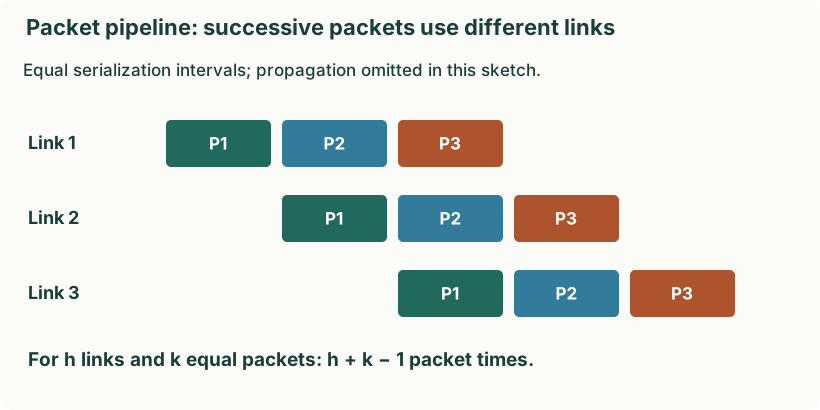
Understand it step by step
- With message switching, the whole message is the forwarding unit. On h equal-rate links, a message of M bits needs hM/R seconds of serialization.
- With k equal packets, the first packet needs h packet-transmission times to cross h links. Each later packet then emerges one packet-transmission time later under ideal equal-rate conditions.
- Thus k packets of L bits take (h+k−1)L/R plus all link propagation delays. This assumes no losses, no queueing, negligible processing, equal packet sizes and equal rates.
- Count links, not routers: three intermediate routers between source and destination create four links. Include packet headers in L if the question supplies them.
 LaTeX:
T_{\mathrm{message}}=hM/R+h\tau LaTeX:
T_{\mathrm{packet}}=(h+k-1)L/R+h\tauPractice question. Explain why packet switching can deliver a large message faster than message switching. [3 practice marks]
Answer
Packet switching can pipeline smaller units across successive links. After the first packet is forwarded, the next packet can use an earlier link while the first uses a later link. Whole-message store-and-forward must receive the entire message at each node, preventing that packet-level pipeline.
Yaad rakho: First packet h times; remaining packets one time each.