Computer Networks · TEE · read
G, S and throughput: which number are you finding?
ALOHA: access, collisions and throughput
TEE · shared foundations and Units 3–4 · current syllabus 702AI0C023
Definition. Offered load G is the average number of transmission attempts per frame time. Normalized throughput S is the average number of successful frames per frame time.
Simple meaning. G = kitne attempts; S = unmein successful output per frame-time. Dono same nahi.
Understand it step by step
- Let L be frame length in bits, R the channel rate in bits/s, and λ the total attempt rate of all stations in frames/s. Then T=L/R seconds and G=λT.
- For the standard model, attempts are modelled as Poisson, frames have equal duration, there is no capture, and overlapping transmissions fail. G includes retransmissions when they are part of the offered traffic.
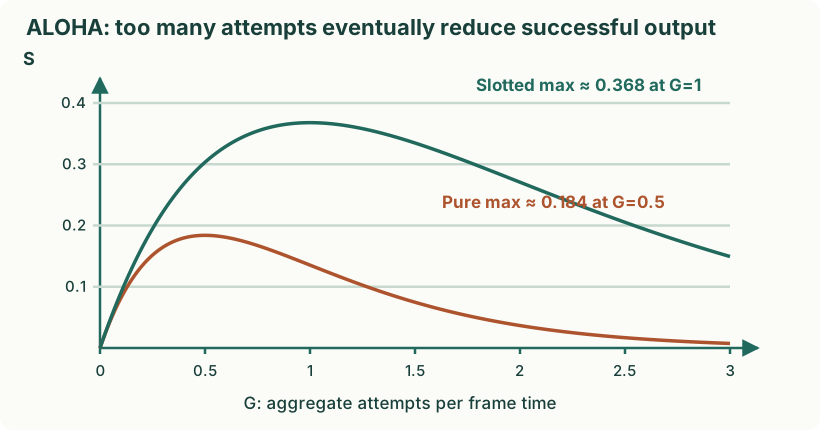
- Pure ALOHA uses S=Ge⁻²ᴳ; Slotted ALOHA uses S=Ge⁻ᴳ. Do not use arrival rate in frames/s directly in the exponent.
- Successful frames/s is S/T. Successful frame bits/s is (S/T)L = SR. If L includes overhead, this is successful frame throughput, not application payload goodput.
- For G>0, the success probability per attempt is S/G. S itself is not generally that probability. Under this fixed-frame ideal model, 100S is the normalized throughput as a percentage of raw bit rate.
 LaTeX:
T=L/R,\qquad G=\lambda T LaTeX:
S_{\mathrm{pure}}=G e^{-2G} LaTeX:
S_{\mathrm{slotted}}=G e^{-G} LaTeX:
\text{successful frames/s}=S/T LaTeX:
\text{successful frame bits/s}=SRPractice question. Write the throughput expressions of Pure and Slotted ALOHA, defining G and S. [3 practice marks]
Answer
G denotes aggregate attempts per frame transmission time and S denotes successful frames per frame transmission time. Pure ALOHA: S=Ge⁻²ᴳ, with maximum 1/(2e) at G=0.5. Slotted ALOHA: S=Ge⁻ᴳ, with maximum 1/e at G=1. These results use the equal-length Poisson collision model.
Yaad rakho: P mein pair: −2G; S mein single: −G.
Important conversion in the faculty examples
For 200-bit frames on a 200000-bit/s channel, T = 200/200000 = 0.001 s. If 500 frames/s attempt transmission, G = 0.5 and pure-ALOHA S = 0.5e⁻¹ ≈ 0.1839397. Convert to frames/s by dividing by T: 0.1839397/0.001 ≈ 183.94 frames/s.
Do not multiply S by 500: S is successful frames per frame-time, not success probability per attempt. Some slide totals use that incorrect conversion. At 250 attempts/s the correct pure-ALOHA output is 151.63 frames/s. Use the definitions and units above.