Computer Networks · TEE · read
IPv6 base header: every field and its purpose
IPv6: addresses and packet format
TEE · shared foundations and Units 3–4 · current syllabus 702AI0C023
Definition. The IPv6 base header is a fixed 40-byte structure containing addressing and forwarding-control fields, followed by optional extension headers and upper-layer data.
Simple meaning. Base header fixed 40 bytes; extra information extension headers mein.
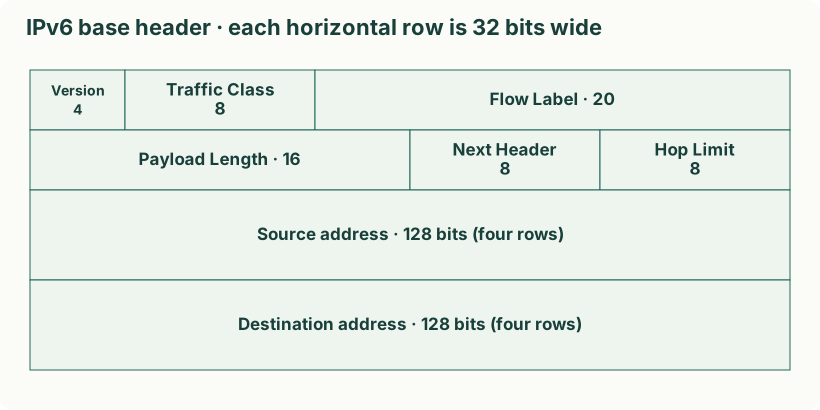
Diagram: IPv6 base header · each horizontal row is 32 bits wide. Labels: IPv6 base header · each horizontal row is 32 bits wide | IPv6 base header · each horizontal row is 32 bits wide | Version | 4 | Traffic Class | 8 | Flow Label · 20 | Payload Length · 16 | Next Header | 8 | Hop Limit | 8 | Source address · 128 bits (four rows) | Destination address · 128 bits (four rows)
Understand it step by step
- Read the header from its control fields to its two 128-bit addresses. Four plus eight plus twenty bits fills the first 32-bit row.
- The first two rows together contribute 64 bits; source and destination contribute 256 bits. Total=320 bits=40 bytes.
- Payload Length counts bytes after the base header, including extension headers when present. It does not include the base 40 bytes.
- Next Header permits chaining: a base header may point to an extension, which points to another extension or TCP/UDP.
- The Hop Limit is reduced by forwarding nodes to prevent indefinite circulation. IPv6 has no base-header checksum, and routers do not fragment IPv6 packets.
| Field | Bits | Purpose |
|---|---|---|
| Version | 4 | Value 6 |
| Traffic Class | 8 | Traffic treatment/congestion-related marking |
| Flow Label | 20 | Identifies a flow for appropriate handling |
| Payload Length | 16 | Bytes after the base header; includes extension headers when present |
| Next Header | 8 | Type of the next extension header or upper-layer protocol |
| Hop Limit | 8 | Decremented on forwarding; limits packet lifetime in hops |
| Source address | 128 | Sending interface address |
| Destination address | 128 | Destination address |
Practice question. Draw the IPv6 base header and explain its fields. [3 practice marks]
Answer
Diagram: IPv6 base header · each horizontal row is 32 bits wide. Labels: IPv6 base header · each horizontal row is 32 bits wide | IPv6 base header · each horizontal row is 32 bits wide | Version | 4 | Traffic Class | 8 | Flow Label · 20 | Payload Length · 16 | Next Header | 8 | Hop Limit | 8 | Source address · 128 bits (four rows) | Destination address · 128 bits (four rows)
| Field | Bits | Purpose |
|---|---|---|
| Version | 4 | Value 6 |
| Traffic Class | 8 | Traffic treatment/congestion-related marking |
| Flow Label | 20 | Identifies a flow for appropriate handling |
| Payload Length | 16 | Bytes after the base header; includes extension headers when present |
| Next Header | 8 | Type of the next extension header or upper-layer protocol |
| Hop Limit | 8 | Decremented on forwarding; limits packet lifetime in hops |
| Source address | 128 | Sending interface address |
| Destination address | 128 | Destination address |
Yaad rakho: IPv6: 40 fixed; payload field excludes those 40.