Deep Learning · MT2 · formulas
Squared and absolute losses
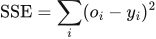
SSE, half SSE and MSE start with the same errors but apply different final divisions. First understand what an error and its square mean. The full question below keeps all three answers separate.
 LaTeX:
\mathrm{SSE}=\sum_i(o_i-y_i)^2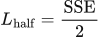 LaTeX:
L_{\mathrm{half}}=\frac{\mathrm{SSE}}2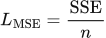 LaTeX:
L_{\mathrm{MSE}}=\frac{\mathrm{SSE}}n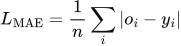 LaTeX:
L_{\mathrm{MAE}}=\frac1n\sum_i|o_i-y_i|Loss: how one wrong prediction becomes a number
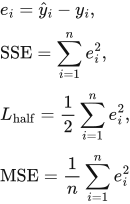
Definition. A residual is the signed prediction error. Squared-error objectives aggregate squared residuals; their scaling convention changes both the reported loss and its derivative.
 LaTeX:
e_i=\hat y_i-y_i,\qquad \mathrm{SSE}=\sum_{i=1}^{n}e_i^2,\qquad L_{\mathrm{half}}=\frac12\sum_{i=1}^{n}e_i^2,\qquad \mathrm{MSE}=\frac1n\sum_{i=1}^{n}e_i^2For this definition of n, each i indexes one included scalar prediction. In a multi-output batch, state whether the mean is over examples, output coordinates, or both. Half SSE and MSE happen to agree when n = 2; they are not generally the same objective.
Derivatives and their scaling
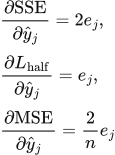
When differentiating with respect to prediction j, all other prediction terms are constant. The derivative of the j-th square is twice its residual:
 LaTeX:
\frac{\partial\mathrm{SSE}}{\partial\hat y_j}=2e_j,\qquad \frac{\partial L_{\mathrm{half}}}{\partial\hat y_j}=e_j,\qquad \frac{\partial\mathrm{MSE}}{\partial\hat y_j}=\frac{2}{n}e_jThe factor 1/2 cancels the derivative's factor 2. The factor 1/n instead produces 2/n. A weight derivative must also multiply by the derivative of the prediction with respect to that weight.
Question. Predictions are [0.2, 0.7, 0.4] and targets are [0, 1, 1]. Find SSE, half SSE and MSE, then their gradients with respect to the prediction vector.
Given
Predictions = [0.2,0.7,0.4].
Targets = [0,1,1]; n = 3 scalar predictions.
To find
Find SSE, half SSE and MSE, then all three prediction-gradient lists.
Formula — which one and why
Squared-error objectives. Calculate signed errors first and square them. SSE adds the squares; half SSE divides that sum by 2; MSE divides by the number of scalar predictions. These denominators are different conventions.
ŷᵢ = prediction; yᵢ = target; eᵢ = signed error; n = number of scalar predictions included in the stated loss.
 LaTeX:
e_i=\hat y_i-y_i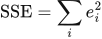 LaTeX:
\mathrm{SSE}=\sum_i e_i^2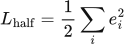 LaTeX:
L_{\mathrm{half}}=\frac12\sum_i e_i^2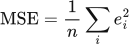 LaTeX:
\mathrm{MSE}=\frac1n\sum_i e_i^2Yaad rakhne ka cue: Pehle error square; phir question ke hisaab se sum, half ya mean.
Solution — step by step
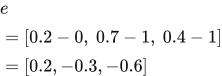
Step 1: calculate the three signed prediction errors.
 LaTeX:
e=[0.2-0,\ 0.7-1,\ 0.4-1]=[0.2,-0.3,-0.6]Step 2: square every error.
 LaTeX:
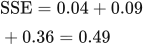
e\odot e=[0.04,0.09,0.36]Step 3: add the three squared errors.
 LaTeX:
\mathrm{SSE}=0.04+0.09+0.36=0.49Step 4: apply the requested loss divisors.
 LaTeX:
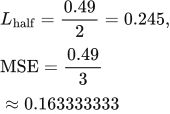
L_{\mathrm{half}}=\frac{0.49}{2}=0.245,\qquad \mathrm{MSE}=\frac{0.49}{3}\approx0.163333333Step 5: multiply every error by 2 for the SSE gradient.
 LaTeX:
\nabla_{\hat y}\mathrm{SSE}=[0.4,-0.6,-1.2]Step 6: use each error itself for the half-SSE gradient.
 LaTeX:
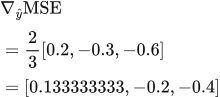
\nabla_{\hat y}L_{\mathrm{half}}=[0.2,-0.3,-0.6]Step 7: multiply every error by 2/3 for the MSE gradient.
 LaTeX:
\nabla_{\hat y}\mathrm{MSE}=\frac23[0.2,-0.3,-0.6]=[0.133333333,-0.2,-0.4]The residual signs survive in the gradients even though the losses are nonnegative. Multiplying a loss by a positive constant leaves its unregularized minimizers unchanged, but scales its gradients and therefore its updates at a fixed learning rate.
Drill 2 Half sum versus mean
Question
Question. Predictions = [0.2,0.7,0.4], targets = [0,1,1]. Find SSE, half SSE and MSE.
Answer — step by step
Given
Predictions = [0.2, 0.7, 0.4].
Targets = [0, 1, 1]; number of outputs n = 3.
To find
Find SSE, half SSE, MSE and the prediction gradients requested in the question.
Formula — which one and why
Squared-error objectives. Calculate signed errors first and square them. SSE adds the squares; half SSE divides that sum by 2; MSE divides by the number of scalar predictions. These denominators are different conventions.
ŷᵢ = prediction; yᵢ = target; eᵢ = signed error; n = number of scalar predictions included in the stated loss.
LaTeX: e_i=\hat y_i-y_iLaTeX: \mathrm{SSE}=\sum_i e_i^2LaTeX: L_{\mathrm{half}}=\frac12\sum_i e_i^2LaTeX: \mathrm{MSE}=\frac1n\sum_i e_i^2Yaad rakhne ka cue: Pehle error square; phir question ke hisaab se sum, half ya mean.
Solution — step by step
Given values and loss definitions
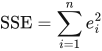
There are n = 3 prediction–target pairs. Use the supplied predictions directly; no rounding to class labels is required. Let eᵢ = ŷᵢ − yᵢ be the signed residual for pair i.
 LaTeX:
\mathrm{SSE}=\sum_{i=1}^{n}e_i^2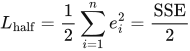 LaTeX:
L_{\mathrm{half}}=\frac12\sum_{i=1}^{n}e_i^2=\frac{\mathrm{SSE}}2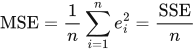 LaTeX:
\mathrm{MSE}=\frac1n\sum_{i=1}^{n}e_i^2=\frac{\mathrm{SSE}}nSSE is the sum of squared errors. Half SSE and MSE rescale that same sum by different denominators: 2 and n, respectively.
Step 1: calculate each residual and its square
| Pair | Prediction ŷᵢ | Target yᵢ | Residual ŷᵢ − yᵢ | Squared residual |
|---|---|---|---|---|
| 1 | 0.2 | 0 | 0.2 − 0 = 0.2 | (0.2)² = 0.04 |
| 2 | 0.7 | 1 | 0.7 − 1 = −0.3 | (−0.3)² = 0.09 |
| 3 | 0.4 | 1 | 0.4 − 1 = −0.6 | (−0.6)² = 0.36 |
Step 2: sum the squared residuals
LaTeX: \mathrm{SSE}=0.04+0.09+0.36=0.49Square each residual before summing. Squaring the sum of signed residuals would be a different quantity, because positive and negative residuals could cancel.
Step 3: apply each requested normalization
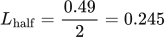
For half SSE, the denominator is 2:
 LaTeX:
L_{\mathrm{half}}=\frac{0.49}{2}=0.245For MSE, the denominator is the number of pairs, n = 3:
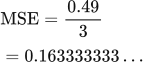 LaTeX:
\mathrm{MSE}=\frac{0.49}{3}=0.163333333\ldotsFinal answer: SSE = 0.49; half SSE = 0.245; MSE ≈ 0.163333. They represent the same residuals at different scales. Half SSE and MSE coincide when n = 2; they do not coincide for these three nonzero residuals. No derivative is required by this question.
Absolute error uses a different operation
Question. Targets are [2, 4] and predictions are [1, 6]. Find mean absolute error.
Given
Targets = [2,4]; predictions = [1,6]; n = 2.
To find
Find mean absolute error.
Formula — which one and why
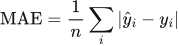
Mean absolute error. Absolute value removes the sign of each prediction error without squaring its magnitude. Average those magnitudes.
n = number of predictions. |e| means the nonnegative magnitude of error e.
 LaTeX:
\mathrm{MAE}=\frac1n\sum_i|\hat y_i-y_i|Yaad rakhne ka cue: MAE mein magnitude; MSE mein square.
Solution — step by step
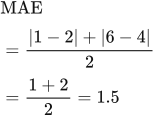
The signed errors are 1 − 2 = −1 and 6 − 4 = 2. Absolute value keeps the size of a number without its sign, so their absolute errors are 1 and 2. Add them to obtain 3. There are two prediction–target pairs, so divide by 2.
 LaTeX:
\mathrm{MAE}=\frac{|1-2|+|6-4|}{2}=\frac{1+2}{2}=1.5Final answer: MAE = 1.5. Do not square the errors for MAE.