Deep Learning · MT2 · formulas
Standardization
Standardization has a meaning before it has a formula: measure how far an input is from its training mean, then express that distance in standard-deviation units. The worked question below calculates the mean and standard deviation first, so neither number appears without explanation.
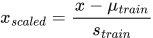 LaTeX:
x_{scaled}=\frac{x-\mu_{train}}{s_{train}}Standardization: what the answer 1 actually means
Definition. Standardization is an affine transformation that expresses an observation as its signed distance from a reference mean, measured in reference standard-deviation units.
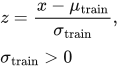 LaTeX:
z=\frac{x-\mu_{\mathrm{train}}}{\sigma_{\mathrm{train}}},\qquad \sigma_{\mathrm{train}}>0Subtracting the mean centres the reference data. Dividing by its standard deviation rescales its spread. The result is dimensionless. A positive z lies above the training mean, a negative z below it, and z = 0 equals it. Standardization does not make an arbitrary distribution Gaussian and does not restrict values to [0,1].
Question. A feature has training values [3, 3, 7, 7]. Using population standard deviation, standardize the training values and a new observation x = 9.
Given
Training observations = [3,3,7,7].
New observation = 9.
Estimate the population standard deviation from the training values.
To find
Find the training mean and standard deviation; standardize all four training values and the new observation.
Formula — which one and why
Mean and spread. The mean is the sum divided by the number of values. Population variance averages squared distances from that mean; standard deviation is its square root.
N = number of values; xᵢ = value i; μ = mean; σ² = variance; σ = standard deviation. Σ means add the indicated terms.
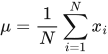 LaTeX:
\mu=\frac{1}{N}\sum_{i=1}^{N}x_i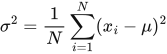 LaTeX:
\sigma^2=\frac{1}{N}\sum_{i=1}^{N}(x_i-\mu)^2 LaTeX:
\sigma=\sqrt{\sigma^2}Yaad rakhne ka cue: Mean = sabka total ÷ count; variance = squared distances ka mean.
Standardization. Subtract the training mean to measure distance from the centre; divide by the training standard deviation to express that distance in standard-deviation units.
x = original value; μ = training mean; σ = training standard deviation, which must be nonzero; z = standardized value.
 LaTeX:
z=\frac{x-\mu}{\sigma}Yaad rakhne ka cue: Pehle centre hatao, phir spread se divide karo.
Solution — step by step
Step 1: add all four observations.
 LaTeX:
3+3+7+7=20Step 2: divide by the count to obtain the mean.
 LaTeX:
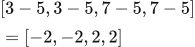
\mu=\frac{20}{4}=5Step 3: subtract the mean from each observation.
 LaTeX:
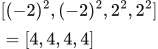
[3-5,3-5,7-5,7-5]=[-2,-2,2,2]Step 4: square each deviation.
 LaTeX:
[(-2)^2,(-2)^2,2^2,2^2]=[4,4,4,4]Step 5: add the squared deviations.
 LaTeX:
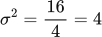
4+4+4+4=16Step 6: divide by four for population variance.
 LaTeX:
\sigma^2=\frac{16}{4}=4Step 7: take the nonnegative square root.
 LaTeX:
\sigma=\sqrt4=2Step 8: standardize each original training observation.
 LaTeX:
\frac{3-5}{2}=-1 LaTeX:
\frac{7-5}{2}=1The repeated observations give [-1, −1, 1, 1].
Step 9: subtract the training mean from the new observation.
 LaTeX:
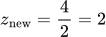
9-5=4Step 10: divide by the training standard deviation.
 LaTeX:
z_{\mathrm{new}}=\frac42=2Answer: the new observation is two training standard deviations above the training mean. Do not recompute the mean and standard deviation using the new observation; validation and test data use the training transformation to avoid leakage. A constant feature has zero standard deviation and needs a stated handling policy.
Standardization with x = 3
Question. Training mean is 5 and training standard deviation is 2. Standardize x = 3 and interpret the result.
Given
x = 3; training mean μ = 5; training standard deviation σ = 2.
To find
Standardized value z and its meaning.
Formula — which one and why
Subtract the training centre, then measure that distance in units of the training standard deviation.
A negative z means below the training mean; positive means above it; zero means equal to it.
LaTeX: z=\frac{x-\mu}{\sigma}Yaad rakhne ka cue: Centre hatao, spread se divide; answer batata hai kitne σ door.
Solution — step by step
Step 1: find distance from the mean.
 LaTeX:
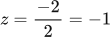
x-\mu=3-5=-2Step 2: divide by one standard-deviation unit.
 LaTeX:
z=\frac{-2}{2}=-1Step 3: interpret sign and size.
The value is 1 standard-deviation unit(s) below the training mean.
Final answer: z = -1. Use the same training statistics when transforming a new test input.
Standardization with x = 5
Question. Training mean is 5 and training standard deviation is 2. Standardize x = 5 and interpret the result.
Given
x = 5; training mean μ = 5; training standard deviation σ = 2.
To find
Standardized value z and its meaning.
Formula — which one and why
Subtract the training centre, then measure that distance in units of the training standard deviation.
A negative z means below the training mean; positive means above it; zero means equal to it.
LaTeX: z=\frac{x-\mu}{\sigma}Yaad rakhne ka cue: Centre hatao, spread se divide; answer batata hai kitne σ door.
Solution — step by step
Step 1: find distance from the mean.
 LaTeX:
x-\mu=5-5=0Step 2: divide by one standard-deviation unit.
 LaTeX:
z=\frac{0}{2}=0Step 3: interpret sign and size.
The value is 0 standard-deviation unit(s) away from the training mean.
Final answer: z = 0. Use the same training statistics when transforming a new test input.
Standardization with x = 9
Question. Training mean is 5 and training standard deviation is 2. Standardize x = 9 and interpret the result.
Given
x = 9; training mean μ = 5; training standard deviation σ = 2.
To find
Standardized value z and its meaning.
Formula — which one and why
Subtract the training centre, then measure that distance in units of the training standard deviation.
A negative z means below the training mean; positive means above it; zero means equal to it.
LaTeX: z=\frac{x-\mu}{\sigma}Yaad rakhne ka cue: Centre hatao, spread se divide; answer batata hai kitne σ door.
Solution — step by step
Step 1: find distance from the mean.
 LaTeX:
x-\mu=9-5=4Step 2: divide by one standard-deviation unit.
 LaTeX:
z=\frac{4}{2}=2Step 3: interpret sign and size.
The value is 2 standard-deviation unit(s) above the training mean.
Final answer: z = 2. Use the same training statistics when transforming a new test input.