Deep Learning · MT2 · formulas
Momentum: signed velocity
Momentum carries some of the previous movement into the next update. Here v is signed movement, so the new parameter is the old parameter plus v. A negative v moves the parameter down. Use the same convention throughout the calculation.
 LaTeX:
v_t=\beta v_{t-1}-\eta g_t LaTeX:
\theta_t=\theta_{t-1}+v_tModel answer: momentum and Nesterov
Question
Question. Explain momentum and Nesterov accelerated gradient. How does the point at which the gradient is measured differ?
Answer — step by step
Momentum retains a fraction of the previous movement and combines it with the current gradient correction. Movement in a persistent direction can build up, while alternating directions can partially cancel. This can reduce zig-zagging and improve progress through poorly scaled regions.
Momentum formulas
This answer uses signed displacement velocity v: a negative velocity moves the parameter left. η is learning rate and β is the fraction of previous velocity retained.
 LaTeX:
g_t=J'(\theta_{t-1})LaTeX: v_t=\beta v_{t-1}-\eta g_tLaTeX: \theta_t=\theta_{t-1}+v_tNesterov's change
Nesterov first forms a lookahead position using the old momentum. It measures the gradient there, then computes a new velocity and updates the actual old parameter.
 LaTeX:
\theta_{\mathrm{look}}=\theta_{t-1}+\beta v_{t-1} LaTeX:
g_t=J'(\theta_{\mathrm{look}})The velocity and parameter update formulas remain as displayed above. Add the new velocity to θ at the previous iteration, not to the lookahead point.
| Basis | Momentum | Nesterov |
|---|---|---|
| Gradient evaluated at | Current parameter | Lookahead parameter |
| Information retained | Previous velocity | Previous velocity |
| Intuition | Continue useful movement | Inspect the slope where old momentum points |
| Initial zero velocity | No movement contribution yet | First lookahead equals current parameter |
Both require suitable learning rate and momentum settings. Neither guarantees the global minimum of a general neural-network objective. Different books use different definitions of stored velocity, so the definition and update must be used together consistently.
Momentum remembers movement
Definition. Momentum is a gradient-based optimization method that combines the current gradient correction with a fraction of the previous parameter displacement. It can accumulate movement along persistent directions and damp some oscillations across alternating directions.
Update equations and convention
This course uses signed displacement velocity v. It already includes the learning rate, and the parameter update adds it to the old parameter:
LaTeX: g_t=J'(\theta_{t-1})LaTeX: v_t=\beta v_{t-1}-\eta g_tLaTeX: \theta_t=\theta_{t-1}+v_tθ is the parameter, η is the learning rate and β controls how much previous displacement is retained, normally with 0 ≤ β < 1. A negative v moves θ in the negative direction. Every parameter has its own velocity; this optimizer state is distinct from the network's trainable parameters.
Complete numerical: two iterations
Question. J(θ) = ½θ², θ₀ = 1, v₀ = 0, η = 0.1, β = 0.9. Find two iterations using signed displacement velocity.
Given
J(θ) = ½θ²; θ₀ = 1; v₀ = 0.
η = 0.1; β = 0.9; signed-displacement velocity.
To find
Find the gradient, velocity and actual parameter after each of two iterations.
Formula — which one and why
Momentum with signed velocity. Combine the retained old displacement with the current downhill correction, then add that signed displacement to the old parameter.
v = signed velocity/displacement; β = momentum coefficient; g = current gradient; η = learning rate. This convention uses +v in the parameter update.
LaTeX: v_t=\beta v_{t-1}-\eta g_tLaTeX: \theta_t=\theta_{t-1}+v_tYaad rakhne ka cue: Pehle velocity banao; phir old parameter mein velocity jodo.
Solution — step by step
Derivative used: differentiating J gives J′(θ) = θ. The gradient must therefore be reevaluated at the current θ on each iteration.
Step 1: Iteration 1: gradient, velocity, parameter.
 LaTeX:
g_1=J'(1)=1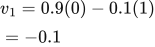 LaTeX:
v_1=0.9(0)-0.1(1)=-0.1 LaTeX:
\theta_1=1+(-0.1)=0.9Step 2: Iteration 2: use θ₁ and v₁.
 LaTeX:
g_2=J'(0.9)=0.9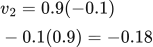 LaTeX:
v_2=0.9(-0.1)-0.1(0.9)=-0.18 LaTeX:
\theta_2=0.9+(-0.18)=0.72| Iteration | Parameter where gradient is evaluated | Gradient | New velocity | New parameter |
|---|---|---|---|---|
| 1 | 1 | 1 | −0.1 | 0.9 |
| 2 | 0.9 | 0.9 | −0.18 | 0.72 |
Final answer: θ₁ = 0.9 and θ₂ = 0.72. At iteration 2, the retained displacement contributes −0.09 and the new gradient correction contributes another −0.09. Their sum explains the larger displacement despite the smaller current gradient.
Properties and alternative notation
Momentum can improve progress through long, poorly scaled valleys, but excessive learning rate or momentum can overshoot. It does not guarantee a global minimum for a general neural-network objective.
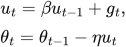
Some texts store a positive gradient accumulator u instead:
 LaTeX:
u_t=\beta u_{t-1}+g_t,\qquad\theta_t=\theta_{t-1}-\eta u_tWith constant η and consistent initialization, this corresponds to vₜ = −ηuₜ. A normalized moving average containing (1−β)gₜ is a different scaling convention. Use the exact recurrence stated in the question instead of combining pieces of different conventions.
Drill 18 Momentum variation 1
Question
Question. J(θ) = ½θ², θ₀ = 1, η = 0.1. Perform two Momentum updates. Use β = 0.9, v₀ = 0 and signed velocity.
Answer — step by step
Given
Objective: J(θ) = ½θ².
Initial θ₀ = 1; η = 0.1; two iterations.
β = 0.9; initial signed velocity v₀ = 0.
To find
Find every stored state needed by the method and the parameter after each of two updates.
Formula — which one and why
Momentum with signed velocity. Combine the retained old displacement with the current downhill correction, then add that signed displacement to the old parameter.
v = signed velocity/displacement; β = momentum coefficient; g = current gradient; η = learning rate. This convention uses +v in the parameter update.
LaTeX: v_t=\beta v_{t-1}-\eta g_tLaTeX: \theta_t=\theta_{t-1}+v_tYaad rakhne ka cue: Pehle velocity banao; phir old parameter mein velocity jodo.
Solution — step by step
Meaning of the symbols
θ (theta) is the number we update. η (eta) is learning rate 0.1. g is the derivative of the objective, evaluated at the required position. A subscript counts updates; θ₀ means the starting value.
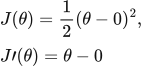
Differentiate the objective first
 LaTeX:
J(\theta)=\frac12(\theta-0)^2,\qquad J\prime(\theta)=\theta-0The power rule brings down 2, which cancels the half. The inside derivative is 1, so the remaining gradient is θ minus 0.
Update formulas
v stores the signed movement from the previous update. β = 0.9 retains 90% of that movement. Start v₀ = 0.
 LaTeX:
g_t=J\prime(\theta_{t-1})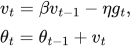 LaTeX:
v_t=\beta v_{t-1}-\eta g_t,\quad \theta_t=\theta_{t-1}+v_tStep 1: Update 1.
 LaTeX:
g_1=1-(0)=1LaTeX: v_1=0.9(0)-0.1(1)=-0.1LaTeX: \theta_1=1+(-0.1)=0.9Step 2: Update 2.
 LaTeX:
g_2=0.9-(0)=0.9LaTeX: v_2=0.9(-0.1)-0.1(0.9)=-0.18LaTeX: \theta_2=0.9+(-0.18)=0.72Final parameter after two updates: 0.72. The second gradient is evaluated again using the parameter obtained after the first update.
Drill 19 Momentum variation 2
Question
Question. J(θ) = ½(θ−1)², θ₀ = -0.5, η = 0.1. Perform two Momentum updates. Use β = 0.9, v₀ = 0 and signed velocity.
Answer — step by step
Given
Objective: J(θ) = ½(θ−1)².
Initial θ₀ = −0.5; η = 0.1; two iterations.
β = 0.9; initial signed velocity v₀ = 0.
To find
Find every stored state needed by the method and the parameter after each of two updates.
Formula — which one and why
Momentum with signed velocity. Combine the retained old displacement with the current downhill correction, then add that signed displacement to the old parameter.
v = signed velocity/displacement; β = momentum coefficient; g = current gradient; η = learning rate. This convention uses +v in the parameter update.
LaTeX: v_t=\beta v_{t-1}-\eta g_tLaTeX: \theta_t=\theta_{t-1}+v_tYaad rakhne ka cue: Pehle velocity banao; phir old parameter mein velocity jodo.
Solution — step by step
Meaning of the symbols
θ (theta) is the number we update. η (eta) is learning rate 0.1. g is the derivative of the objective, evaluated at the required position. A subscript counts updates; θ₀ means the starting value.
Differentiate the objective first
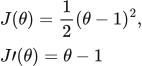 LaTeX:
J(\theta)=\frac12(\theta-1)^2,\qquad J\prime(\theta)=\theta-1The power rule brings down 2, which cancels the half. The inside derivative is 1, so the remaining gradient is θ minus 1.
Update formulas
v stores the signed movement from the previous update. β = 0.9 retains 90% of that movement. Start v₀ = 0.
LaTeX: g_t=J\prime(\theta_{t-1})LaTeX: v_t=\beta v_{t-1}-\eta g_t,\quad \theta_t=\theta_{t-1}+v_tStep 1: Update 1.
 LaTeX:
g_1=-0.5-(1)=-1.5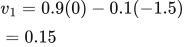 LaTeX:
v_1=0.9(0)-0.1(-1.5)=0.15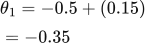 LaTeX:
\theta_1=-0.5+(0.15)=-0.35Step 2: Update 2.
 LaTeX:
g_2=-0.35-(1)=-1.35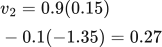 LaTeX:
v_2=0.9(0.15)-0.1(-1.35)=0.27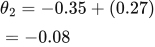 LaTeX:
\theta_2=-0.35+(0.27)=-0.08Final parameter after two updates: -0.08. The second gradient is evaluated again using the parameter obtained after the first update.