Deep Learning · MT2 · formulas
Global average pooling
Global average pooling takes one mean per complete spatial channel. The worked example compares the resulting dense classifier with a classifier after flattening.
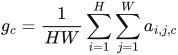 LaTeX:
g_c=\frac{1}{HW}\sum_{i=1}^{H}\sum_{j=1}^{W}a_{i,j,c}Global average pooling: one average for each channel
Definition. Global average pooling, or GAP, replaces every complete spatial feature map by its mean. An H × W × C tensor becomes C numbers. The channels remain separate; we do not average all channels into one number.
LaTeX: g_c=\frac{1}{HW}\sum_{i=1}^{H}\sum_{j=1}^{W}a_{i,j,c}The letter c selects a channel; i and j select its row and column; a is the value at that location. Add all H × W entries in that channel and divide by H × W. GAP has no learned weights or biases. A classifier after GAP can still have trainable parameters. In GoogLeNet, 7 × 7 × 1,024 becomes 1 × 1 × 1,024 before the final 1,000-class linear classifier.
Question (practice, 3 marks). A 2 × 2 × 2 tensor has channel A =  LaTeX:
\begin{bmatrix}1 & 3\\5 & 7\end{bmatrix} and channel B =  LaTeX:
\begin{bmatrix}2 & 4\\6 & 8\end{bmatrix}. Apply GAP, then find the parameters of a three-output dense classifier receiving the result, including one bias per output.
Given
H = 2, W = 2, C = 2. Each of the two channels contains four values. The classifier has three outputs.
To find
The GAP result and dense-head parameter count.
Formula — which one and why
Use one mean per channel. The dense layer receives two numbers, so each of its three outputs needs two weights and one bias.
 LaTeX:
P_{\mathrm{dense}}=(n_{\mathrm{in}}+1)n_{\mathrm{out}}Solution — step by step
Step 1: add channel A. 1 + 3 + 5 + 7 = 16.
Step 2: average channel A. 16 ÷ 4 = 4.
Step 3: add channel B. 2 + 4 + 6 + 8 = 20.
Step 4: average channel B. 20 ÷ 4 = 5. Thus GAP outputs [4,5].
Step 5: count the classifier's weights. 2 inputs × 3 outputs = 6 weights.
Step 6: add three biases. 6 + 3 = 9 parameters. GAP itself contributes zero.
Final answer: GAP = [4,5]; GAP shape = 1 × 1 × 2; classifier parameters = 9. If we flattened all eight inputs instead, that head would require (8 + 1) × 3 = 27 parameters.
Yaad rakho: ek channel ka poora average; channels ko aapas mein mat milao.