Deep Learning · MT2 · formulas
Top-k error percentage
Top-k error counts examples whose correct class is absent from the highest-scoring k predictions. Success counts must not be added twice.
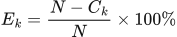 LaTeX:
E_k=\frac{N-C_k}{N}\times100\%Top-1 and top-5 error: what an ImageNet result means
Top-1 prediction is the class with the highest score. A top-1 mistake occurs when that class is wrong. Top-5 prediction is the list of the five highest-scoring classes. A top-5 mistake occurs only when the correct class is absent from that list. It is not the average error of five separate models.
For an image of a cat, the ordered list dog, cat, fox, horse, bird is a top-1 error but a top-5 success. The ordered list dog, fox, horse, bird, car is an error under both measures.
Question (practice, 2 marks). A classifier evaluates 100 images. The correct class is ranked first for 78 images and appears somewhere in the first five positions for 92 images. Calculate top-1 error and top-5 error.
Given
Total images = 100; top-1 successes = 78; top-5 successes = 92. The 78 first-place successes are already included in the 92 top-five successes.
To find
The percentage of mistakes under each rule.
Formula — which one and why
Subtract successful images from the total to obtain mistakes. Divide mistakes by the total and multiply by 100 to express a percentage.
LaTeX: E_k=\frac{N-C_k}{N}\times100\%N means total evaluated images; C_k means images whose correct class appears among the top k predictions.
Solution — step by step
Step 1: top-1 mistakes. 100 − 78 = 22.
Step 2: top-1 error percentage.
 LaTeX:
E_1=\frac{22}{100}\times100\%=22\%Step 3: top-5 mistakes. 100 − 92 = 8.
Step 4: top-5 error percentage.
 LaTeX:
E_5=\frac{8}{100}\times100\%=8\%Final answer: top-1 error = 22%; top-5 error = 8%. A broader acceptable list makes top-5 error no greater than top-1 error for the same evaluated predictions.
Yaad rakho: top-five mein sahi naam mil gaya toh top-five success.