Deep Learning · MT2 · section
MT1B Q3
Prerequisite repair and teacher backprop examples
Question
Question (3 marks). Calculate sigmoid, ReLU and tanh for z = [−2,0,2].
Answer — step by step
Given
Input scores = [−2,0,2].
Required activations: sigmoid, ReLU and tanh.
To find
Calculate all three activation outputs for each score.
Formula — which one and why
Sigmoid and its slope. Use sigmoid when the neuron is specified to squash its preactivation into (0,1). Once its output is known, its derivative needs only output × (1−output).
z = preactivation; p = sigmoid output; e is the exponential base, not a prediction error in this formula.
 LaTeX:
p=\frac{1}{1+e^{-z}}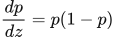 LaTeX:
\frac{dp}{dz}=p(1-p)Yaad rakhne ka cue: Sigmoid output p; uska slope p × (1−p).
ReLU and Leaky ReLU. ReLU returns zero for negative input and retains positive input. Leaky ReLU instead multiplies a negative input by its supplied slope.
z = preactivation; α (alpha) = supplied negative-side slope for Leaky ReLU. The derivative at zero needs an explicit convention.
 LaTeX:
\operatorname{ReLU}(z)=\max(0,z) LaTeX:
\operatorname{LeakyReLU}(z)=\begin{cases}z&z\ge0\\\alpha z&z<0\end{cases}Yaad rakhne ka cue: Positive ko rehne do; negative ko zero. Leaky mein chhota negative rehne do.
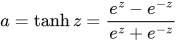
Tanh and its slope. Tanh preserves a signed output between −1 and 1. Once its output a is known, the local slope is 1−a².
z = value entering tanh; a = its output. A prime means derivative, or local rate of change.
 LaTeX:
a=\tanh z=\frac{e^z-e^{-z}}{e^z+e^{-z}}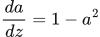 LaTeX:
\frac{da}{dz}=1-a^2Yaad rakhne ka cue: Tanh signed output deta hai; slope = 1 minus output ka square.
Solution — step by step
Preactivation z = -2
Step 1: negate z for sigmoid.
 LaTeX:
-z=2Step 2: evaluate the exponential.
 LaTeX:
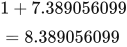
e^{-z}\approx7.389056099Step 3: add one to form the denominator.
 LaTeX:
1+7.389056099=8.389056099Step 4: take the reciprocal for sigmoid.
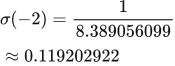 LaTeX:
\sigma(-2)=\frac1{8.389056099}\approx0.119202922Step 5: compare z with zero for ReLU.
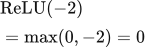 LaTeX:
\mathrm{ReLU}(-2)=\max(0,-2)=0Step 6: calculate the tanh numerator.
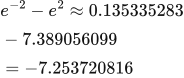 LaTeX:
e^{-2}-e^{2}\approx0.135335283-7.389056099=-7.253720816Step 7: calculate the tanh denominator.
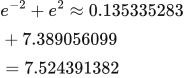 LaTeX:
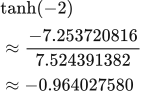
e^{-2}+e^{2}\approx0.135335283+7.389056099=7.524391382Step 8: divide for tanh.
 LaTeX:
\tanh(-2)\approx\frac{-7.253720816}{7.524391382}\approx-0.964027580Preactivation z = 0
Step 1: negate z for sigmoid.
 LaTeX:
-z=0Step 2: evaluate the exponential.
 LaTeX:
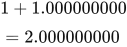
e^{-z}\approx1.000000000Step 3: add one to form the denominator.
 LaTeX:
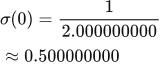
1+1.000000000=2.000000000Step 4: take the reciprocal for sigmoid.
 LaTeX:
\sigma(0)=\frac1{2.000000000}\approx0.500000000Step 5: compare z with zero for ReLU.
 LaTeX:
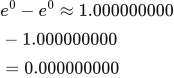
\mathrm{ReLU}(0)=\max(0,0)=0Step 6: calculate the tanh numerator.
 LaTeX:
e^{0}-e^{0}\approx1.000000000-1.000000000=0.000000000Step 7: calculate the tanh denominator.
 LaTeX:
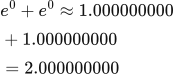
e^{0}+e^{0}\approx1.000000000+1.000000000=2.000000000Step 8: divide for tanh.
 LaTeX:
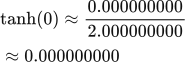
\tanh(0)\approx\frac{0.000000000}{2.000000000}\approx0.000000000Preactivation z = 2
Step 1: negate z for sigmoid.
 LaTeX:
-z=-2Step 2: evaluate the exponential.
 LaTeX:
e^{-z}\approx0.135335283Step 3: add one to form the denominator.
 LaTeX:
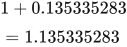
1+0.135335283=1.135335283Step 4: take the reciprocal for sigmoid.
 LaTeX:
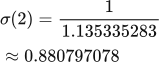
\sigma(2)=\frac1{1.135335283}\approx0.880797078Step 5: compare z with zero for ReLU.
 LaTeX:
\mathrm{ReLU}(2)=\max(0,2)=2Step 6: calculate the tanh numerator.
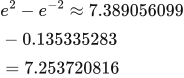 LaTeX:
e^{2}-e^{-2}\approx7.389056099-0.135335283=7.253720816Step 7: calculate the tanh denominator.
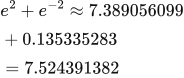 LaTeX:
e^{2}+e^{-2}\approx7.389056099+0.135335283=7.524391382Step 8: divide for tanh.
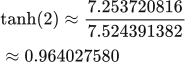 LaTeX:
\tanh(2)\approx\frac{7.253720816}{7.524391382}\approx0.964027580Final answer: sigmoid = [0.119202922, 0.5, 0.880797078]; ReLU = [0, 0, 2]; tanh = [−0.964027580, 0, 0.964027580].