Deep Learning · MT2 · section
Drill 10 Sigmoid neuron gradient
MT2 numerical practice from direct to mixed
Question
Question. x = 2, w = 0.5, b = 0, y = 1, half squared loss, η = 0.1. Find one weight and bias update.
Answer — step by step
Given
x = 2; w = 0.5; b = 0; target y = 1.
Activation: sigmoid; loss: half squared error.
Learning rate η = 0.1.
To find
Find the output, delta, weight/bias gradients and one update.
Formula — which one and why
Weighted sum and activation. Each input is multiplied by its connection weight. Add these contributions, add the bias once, then apply the stated activation.
xᵢ = input i; wᵢ = its weight; b = bias; z = sum before activation; a = output after activation; f = the specified activation function.
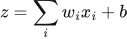 LaTeX:
z=\sum_iw_ix_i+b LaTeX:
a=f(z)Yaad rakhne ka cue: Input × weight, sabka sum, bias once, phir activation.
Sigmoid and its slope. Use sigmoid when the neuron is specified to squash its preactivation into (0,1). Once its output is known, its derivative needs only output × (1−output).
z = preactivation; p = sigmoid output; e is the exponential base, not a prediction error in this formula.
 LaTeX:
p=\frac{1}{1+e^{-z}}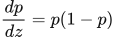 LaTeX:
\frac{dp}{dz}=p(1-p)Yaad rakhne ka cue: Sigmoid output p; uska slope p × (1−p).
Half summed squared loss. This loss convention takes one-half of the sum of squared prediction errors. Use it when the question specifies it, or explicitly state it as an assumption when the paper omits the loss. Differentiating cancels the factor one-half against the square derivative.
oⱼ = output j; yⱼ = target j; L = half summed squared loss under the stated or explicitly assumed convention.
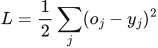 LaTeX:
L=\frac12\sum_j(o_j-y_j)^2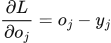 LaTeX:
\frac{\partial L}{\partial o_j}=o_j-y_jYaad rakhne ka cue: Half aur square ka 2 cancel: output derivative = prediction − target.
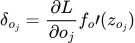
Backpropagation. The loss tells us how each output must change. Multiply by that neuron’s activation slope to obtain its delta. A weight gradient is receiving delta × sending value. Hidden deltas must include every outgoing path.
δ (delta) = derivative of loss with respect to a neuron’s preactivation; f′ = activation derivative; aᵢ = sending activation; Wⱼᵢ = connection weight. Use the exact loss scaling in the question.
 LaTeX:
\delta_{o_j}=\frac{\partial L}{\partial o_j}f_o\prime(z_{o_j})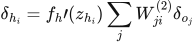 LaTeX:
\delta_{h_i}=f_h\prime(z_{h_i})\sum_jW_{ji}^{(2)}\delta_{o_j}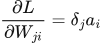 LaTeX:
\frac{\partial L}{\partial W_{ji}}=\delta_ja_i LaTeX:
\frac{\partial L}{\partial b_j}=\delta_j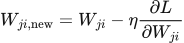 LaTeX:
W_{ji,\mathrm{new}}=W_{ji}-\eta\frac{\partial L}{\partial W_{ji}}Yaad rakhne ka cue: Receiving delta × sending value = us connection ka gradient.
Solution — step by step
Meaning and formulas
Here the loss is half squared error. It is different from binary cross-entropy, so we include the sigmoid derivative explicitly.
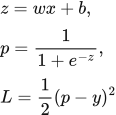 LaTeX:
z=wx+b,\quad p=\frac1{1+e^{-z}},\quad L=\frac12(p-y)^2The symbol δ (delta) is a short name for the loss gradient with respect to the neuron's raw score z.
 LaTeX:
\delta=(p-y)p(1-p)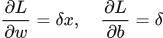 LaTeX:
\frac{\partial L}{\partial w}=\delta x,\quad \frac{\partial L}{\partial b}=\delta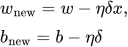 LaTeX:
w_{\mathrm{new}}=w-\eta\delta x,\quad b_{\mathrm{new}}=b-\eta\deltaStep 1: weighted sum and sigmoid
 LaTeX:
z=0.5\times2+0=1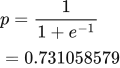 LaTeX:
p=\frac1{1+e^{-1}}=0.731058579Step 2: error and activation slope
 LaTeX:
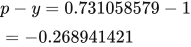
p-y=0.731058579-1=-0.268941421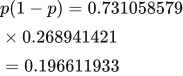 LaTeX:
p(1-p)=0.731058579\times0.268941421=0.196611933Step 3: multiply the linked effects to obtain delta
 LaTeX:
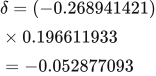
\delta=(-0.268941421)\times0.196611933=-0.052877093Step 4: multiply delta by the input to each parameter
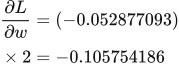
The weight receives x = 2. The bias effectively receives the constant input 1.
 LaTeX:
\frac{\partial L}{\partial w}=(-0.052877093)\times2=-0.105754186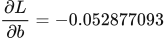 LaTeX:
\frac{\partial L}{\partial b}=-0.052877093Step 5: subtract learning rate times each gradient
 LaTeX:
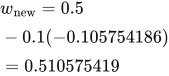
w_{\mathrm{new}}=0.5-0.1(-0.105754186)=0.510575419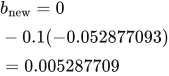 LaTeX:
b_{\mathrm{new}}=0-0.1(-0.052877093)=0.005287709Final answer: new weight ≈ 0.510575419; new bias ≈ 0.005287709. Subtracting negative gradients increases both values here.