Deep Learning · MT2 · section
Drill 28 Regularized objective
MT2 numerical practice from direct to mixed
Question
Question. Data loss = 0.4, w = [−2,1,0.5], λ = 0.1. Calculate L1 objective and L2 objective using (λ/2)Σw².
Answer — step by step
Given
Data loss = 0.4; weights = [−2,1,0.5]; λ = 0.1.
For L2, the question includes the factor ½.
To find
Find each penalty and the total L1/L2 objective.
Formula — which one and why
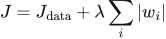
L1 penalty and gradient. Add absolute weight magnitudes to penalize large weights. Away from zero, the penalty derivative depends on the weight’s sign.
λ (lambda) = penalty strength; J_data = data loss; sign(w) is +1 for positive and −1 for negative weights. At zero a subgradient convention is needed.
 LaTeX:
J=J_{\mathrm{data}}+\lambda\sum_i|w_i| LaTeX:
g_i=g_{\mathrm{data},i}+\lambda\operatorname{sign}(w_i)Yaad rakhne ka cue: L1 absolute values leta hai; gradient mein sign aata hai.
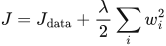
L2 penalty with a factor of one-half. Square each weight, sum and multiply by λ/2. The one-half cancels the factor 2 when differentiating, so the extra gradient is λw.
λ = penalty strength; w = old weight; J_data and g_data = data loss and its gradient.
 LaTeX:
J=J_{\mathrm{data}}+\frac\lambda2\sum_iw_i^2 LaTeX:
g_i=g_{\mathrm{data},i}+\lambda w_i LaTeX:
w_i^{\mathrm{new}}=w_i-\eta g_iYaad rakhne ka cue: Half wala L2 derivative mein lambda × weight deta hai.
Solution — step by step
Meaning and formulas
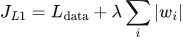
The data loss measures prediction error. A regularization penalty adds a cost for large weights. The objective J is the total being minimized. λ sets the strength of the penalty.
 LaTeX:
J_{L1}=L_{\mathrm{data}}+\lambda\sum_i|w_i|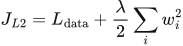 LaTeX:
J_{L2}=L_{\mathrm{data}}+\frac\lambda2\sum_iw_i^2Absolute value means ignore the sign. Squaring means multiply the number by itself. These are different operations.
Step 1: Part A: L1 objective.
 LaTeX:
|-2|=2,\quad |1|=1,\quad |0.5|=0.5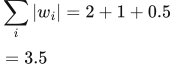 LaTeX:
\sum_i|w_i|=2+1+0.5=3.5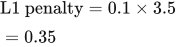 LaTeX:
\text{L1 penalty}=0.1\times3.5=0.35 LaTeX:
J_{L1}=0.4+0.35=0.75Step 2: Part B: L2 objective with the given half.
 LaTeX:
(-2)^2=4,\quad 1^2=1,\quad 0.5^2=0.25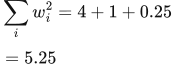 LaTeX:
\sum_iw_i^2=4+1+0.25=5.25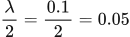 LaTeX:
\frac\lambda2=\frac{0.1}2=0.05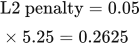 LaTeX:
\text{L2 penalty}=0.05\times5.25=0.2625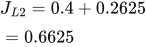 LaTeX:
J_{L2}=0.4+0.2625=0.6625Final answer: L1 objective 0.75; L2 objective 0.6625. These are total objectives, not just penalty values.