Deep Learning · MT2 · section
Drill 3 Natural log and probability
MT2 numerical practice from direct to mixed
Question
Question. Compute −ln(0.9),−ln(0.1), and  LaTeX:
e^{-\ln 2}.
Answer — step by step
Given
Probabilities: 0.9 and 0.1.
Exponential expression: exp(−ln 2).
To find
Find −ln(0.9), −ln(0.1) and exp(−ln 2).
Formula — which one and why
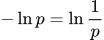
Natural logarithms. The natural logarithm reverses the exponential. A negative log turns a small correct-class probability into a larger positive loss.
ln uses base e ≈ 2.71828. exp(a) means e raised to the power a. Keep the minus outside ln when the question says −ln(p).
 LaTeX:
-\ln p=\ln\frac1p LaTeX:
e^{\ln a}=a LaTeX:
e^{-\ln a}=\frac1aYaad rakhne ka cue: exp banata hai power; ln us power ko wapas nikaalta hai.
Solution — step by step
Meaning and formulas
The natural logarithm ln tells us the power of e needed to obtain a number. It reverses the exponential operation. A calculator evaluates ln; it is not ordinary division.
 LaTeX:
\ln(e^a)=a,\qquad e^{\ln a}=a\quad(a>0) LaTeX:
e^{-a}=\frac1{e^a}Step 1: calculate the first logarithm, then its minus sign
 LaTeX:
\ln(0.9)\approx-0.105360516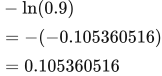 LaTeX:
-\ln(0.9)=-(-0.105360516)=0.105360516Step 2: calculate the second logarithm
 LaTeX:
\ln(0.1)\approx-2.302585093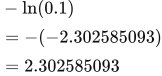 LaTeX:
-\ln(0.1)=-(-2.302585093)=2.302585093When these are correct-class probabilities, 0.1 represents a worse prediction than 0.9, so its negative-log loss is larger.
Step 3: simplify the exponential using the inverse rule
 LaTeX:
e^{-\ln2}=\frac1{e^{\ln2}}=\frac12=0.5Final answers: 0.105360516, 2.302585093 and 0.5. Use the ln key; base-10 log gives different first and second answers.