Deep Learning · MT2 · section
Drill 38 Residual addition
MT2 numerical practice from direct to mixed
Question
Question. x = [2,−3,1], F(x) = [−1,1,0.5]. Calculate residual output before and after ReLU and compare the plain block.
Answer — step by step
Given
x = [2,−3,1]; F(x) = [−1,1,0.5].
To find
Find x+F(x), apply ReLU, and compare with ReLU(F(x)).
Formula — which one and why
Residual addition. Add corresponding components of the input shortcut and learned branch. Apply the output activation afterward if requested.
x = shortcut/input; F(x) = residual branch output. Both arrays must have matching shapes before addition.
 LaTeX:
y=x+F(x)Yaad rakhne ka cue: Same position ke numbers add; shape same rehni chahiye.
ReLU and Leaky ReLU. ReLU returns zero for negative input and retains positive input. Leaky ReLU instead multiplies a negative input by its supplied slope.
z = preactivation; α (alpha) = supplied negative-side slope for Leaky ReLU. The derivative at zero needs an explicit convention.
 LaTeX:
\operatorname{ReLU}(z)=\max(0,z) LaTeX:
\operatorname{LeakyReLU}(z)=\begin{cases}z&z\ge0\\\alpha z&z<0\end{cases}Yaad rakhne ka cue: Positive ko rehne do; negative ko zero. Leaky mein chhota negative rehne do.
Solution — step by step
Meaning and formulas
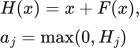
The main branch produces F(x). The shortcut carries x. A residual join adds matching entries from these equally sized vectors. ReLU is a separate operation after that join.
 LaTeX:
H(x)=x+F(x),\qquad a_j=\max(0,H_j)Step 1: add each pair
 LaTeX:
H_1=2+(-1)=1 LaTeX:
H_2=-3+1=-2 LaTeX:
H_3=1+0.5=1.5The residual output before ReLU is [1, −2, 1.5].
Step 2: apply ReLU
 LaTeX:
[\max(0,1),\max(0,-2),\max(0,1.5)]=[1,0,1.5]Step 3: compare with the plain branch
Without a shortcut, the raw output is just F(x) = [−1, 1, 0.5]. Its ReLU output is [0, 1, 0.5].
Residual addition keeps three entries. Concatenation would join the vectors into six entries and is a different operation.