Deep Learning · MT2 · section
Powers roots and very small numbers
Mathematics revision
1. A power counts repeated multiplication
In 2³, 2 is the base and 3 is the exponent. For a positive whole-number exponent, multiply that many copies of the base. It does not mean 2 × 3.
 LaTeX:
2^3=2\times2\times2=8The exponent 2 is called a square: 3² = 3 × 3 = 9. Three rows of three cells make nine cells.
2. A negative number must stay inside its brackets
Squaring negative 2 means multiplying negative 2 by negative 2. The equal signs of the factors give a positive result.
 LaTeX:
(-2)^2=(-2)(-2)=4Without brackets, −2² means first calculate 2², then apply the minus sign: −(4) = −4. Enter brackets when the entire negative number is the base.
For decimals, use the same rule. Negative 0.3 squared is positive 0.09 because 3/10 multiplied by 3/10 is 9/100.
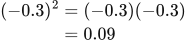 LaTeX:
\begin{aligned}(-0.3)^2&=(-0.3)(-0.3)\\&=0.09\end{aligned}3. A square root asks which nonnegative number was squared
Because 3 × 3 = 9, the principal square root of 9 is 3. Although (−3)² also equals 9, the symbol √9 by itself means the nonnegative root, 3.
 LaTeX:
\begin{aligned}\sqrt9&=3\\\sqrt{0.09}&=0.3\end{aligned}The absolute value of a number is its distance from zero: |−4| = 4 and |4| = 4. Squaring and taking a square root returns this nonnegative size.
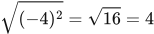 LaTeX:
\sqrt{(-4)^2}=\sqrt{16}=44. Zero and negative exponents follow a pattern
Start with powers of 10. Each time the exponent decreases by 1, divide the previous value by 10: 1000 → 100 → 10 → 1 → 0.1 → 0.01. This explains both the zero power and the negative powers.
| Power | Calculation | Value |
|---|---|---|
| 10³ | 10 × 10 × 10 | 1000 |
| 10² | 1000 ÷ 10 | 100 |
| 10¹ | 100 ÷ 10 | 10 |
| 10⁰ | 10 ÷ 10 | 1 |
| 10⁻¹ | 1 ÷ 10 | 0.1 |
| 10⁻² | 0.1 ÷ 10 | 0.01 |
| 10⁻³ | 0.01 ÷ 10 | 0.001 |
For a nonzero base, power zero is 1. A negative exponent means the reciprocal of the corresponding positive power. It does not mean a negative answer.
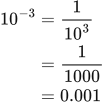 LaTeX:
\begin{aligned}10^{-3}&=\frac1{10^3}\\&=\frac1{1000}\\&=0.001\end{aligned}5. Tiny scientific notation is still an ordinary number
The notation 1 × 10⁻⁸ equals 0.00000001. Calculators may display it as 1E−8. In optimizer formulas, ε, pronounced “epsilon”, often names a small positive constant added to a denominator. Read its supplied value before calculating.
Question. Calculate 1 − 0.9².
Given
Expression: 1−0.9².
To find
Evaluate the power first, then the subtraction.
Formula — which one and why
A square before subtraction. The exponent applies to 0.9. Squaring is repeated multiplication; perform it before subtracting the result from 1.
q denotes the number being squared. Parentheses would be required to square the whole difference.
 LaTeX:
q^2=q\times q LaTeX:
1-q^2=1-(q\times q)Yaad rakhne ka cue: Jis number pe power hai, sirf uska square; subtraction baad mein.
Solution — step by step
Step 1: square only the 0.9.
 LaTeX:
0.9^2=0.9(0.9)=0.81Step 2: subtract the result from 1.
 LaTeX:
1-0.81=0.19Final answer: 0.19. The square acts on 0.9, not on the entire difference.
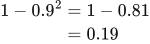 LaTeX:
\begin{aligned}1-0.9^2&=1-0.81\\&=0.19\end{aligned}