Deep Learning · MT2 · section
Partial derivatives hold other things still
The maths behind a network
For z = wx + b, the derivative with respect to w is x, because x is held fixed. The derivative with respect to b is 1. The derivative with respect to x is w. This is the entire local maths of a neuron’s weighted sum.
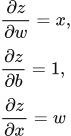 LaTeX:
\frac{\partial z}{\partial w}=x,\qquad \frac{\partial z}{\partial b}=1,\qquad \frac{\partial z}{\partial x}=wQuestion: z = 3w + b, w = 2, b = 1. Find z, ∂z/∂w and ∂z/∂b.
Given
z = 3w+b; w = 2; b = 1.
To find
Find z, ∂z/∂w and ∂z/∂b.
Formula — which one and why
Partial derivatives. Differentiate only with respect to the named variable; all other independent inputs and parameters remain fixed.
∂z/∂w reads “rate of change of z when w changes”. For z = wx+b, x is the coefficient of w, while b has coefficient 1.
 LaTeX:
\frac{\partial z}{\partial w}=x LaTeX:
\frac{\partial z}{\partial b}=1Yaad rakhne ka cue: Neeche jis letter ka naam hai, sirf usko change samjho.
Solution — step by step
Step 1: calculate the function value.
 LaTeX:
z=3(2)+1=6+1=7Step 2: differentiate with respect to w while b is fixed.
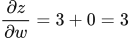 LaTeX:
\frac{\partial z}{\partial w}=3+0=3Step 3: differentiate with respect to b while w is fixed.
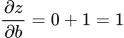 LaTeX:
\frac{\partial z}{\partial b}=0+1=1Final answer: z = 7; weight derivative = 3; bias derivative = 1. A function value and its rate of change are different quantities.