Deep Learning · MT2 · section
Forward propagation through multiple neurons
Neural-network foundations
Definitions. A feedforward neural network has a directed acyclic computation graph: information moves from inputs toward outputs without recurrent feedback connections. A multilayer perceptron (MLP) is a feedforward network built from fully connected layers, with one or more hidden layers and nonlinear hidden activations.
Input, hidden and output layers
The input layer supplies the feature vector. A hidden layer learns an intermediate representation; its outputs are computed from preceding activations, not supplied as target labels. The output layer produces the prediction in the form needed by the task.
In a dense connection between two layers, every receiving neuron has a weight for every preceding activation. Each receiving neuron also normally has its own bias. An ANN is the broader family containing feedforward and recurrent models. A CNN can be feedforward without being an MLP, because convolution uses local shared connections.
General layer equations and dimensions
Let a⁽⁰⁾ = x. For layer l:
 LaTeX:
z^{(l)}=W^{(l)}a^{(l-1)}+b^{(l)} LaTeX:
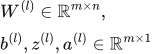
a^{(l)}=f^{(l)}(z^{(l)})If the preceding layer has n inputs and the current layer has m neurons, W has m rows and n columns. The vectors z, a and b have m components. Row j of W contains the incoming weights of neuron j.
 LaTeX:
W^{(l)}\in\mathbb R^{m\times n},\qquad b^{(l)},z^{(l)},a^{(l)}\in\mathbb R^{m\times1}For one hidden layer, these computations compose to give:
 LaTeX:
h=f^{(1)}(W^{(1)}x+b^{(1)}) LaTeX:
\hat y=f^{(2)}(W^{(2)}h+b^{(2)})The hidden activation must be nonlinear to obtain nonlinear representational power. Stacking affine layers alone still gives one affine mapping. A single threshold perceptron cannot separate XOR; a hidden nonlinear representation can make the two classes separable for the output layer.
Forward propagation versus training
Forward propagation evaluates these layer equations using the current parameters. Training additionally evaluates a loss, uses backpropagation to calculate gradients, and applies an optimizer update. The architecture specifies connections; backpropagation is a differentiation algorithm used to train that architecture.
Complete two-layer numerical
Question. A feedforward network receives x = [1, 0]ᵀ. Its hidden-layer weights are W¹ =  LaTeX:
\begin{bmatrix}0.2 & 0.4\\0.3 & 0.7\end{bmatrix} and biases are b¹ = [0.1, 0.2]ᵀ. The output weights are W² = [0.5, 0.6] and output bias is b² = 0.1. Use ReLU in both layers and one row per receiving neuron. Calculate every preactivation and the final output.
Given
A feedforward network receives x = [1, 0]ᵀ.
Its hidden-layer weights are W¹ = LaTeX: \begin{bmatrix}0.2 & 0.4\\0.3 & 0.7\end{bmatrix} and biases are b¹ = [0.1, 0.2]ᵀ.
The output weights are W² = [0.5, 0.6] and output bias is b² = 0.1.
Use ReLU in both layers and one row per receiving neuron.
To find
Find all preactivations, hidden activations and final outputs. Find the requested activation values and slopes.
Formula — which one and why
Forward propagation. Evaluate one layer completely before supplying its activated outputs to the next layer. Each layer has its own weights and biases.
x = input vector; h = hidden outputs; W₁,b₁ = hidden parameters; W₂,b₂ = output parameters; f₁,f₂ = the stated activations.
 LaTeX:
z_h=W_1x+b_1 LaTeX:
h=f_1(z_h) LaTeX:
z_o=W_2h+b_2 LaTeX:
o=f_2(z_o)Yaad rakhne ka cue: Pehli layer ka activated output hi agli layer ka input hai.
ReLU and Leaky ReLU. ReLU returns zero for negative input and retains positive input. Leaky ReLU instead multiplies a negative input by its supplied slope.
z = preactivation; α (alpha) = supplied negative-side slope for Leaky ReLU. The derivative at zero needs an explicit convention.
 LaTeX:
\operatorname{ReLU}(z)=\max(0,z) LaTeX:
\operatorname{LeakyReLU}(z)=\begin{cases}z&z\ge0\\\alpha z&z<0\end{cases}Yaad rakhne ka cue: Positive ko rehne do; negative ko zero. Leaky mein chhota negative rehne do.
Solution — step by step
Step 1: identify the matrix dimensions. W¹ is 2 × 2 and x is 2 × 1, so the hidden preactivation has two entries. W² is 1 × 2, so it takes those two activations and produces one output.
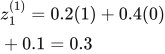
Step 2: calculate the first hidden preactivation. Multiply the first row by x, then add the first hidden bias.
 LaTeX:
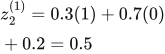
z^{(1)}_1=0.2(1)+0.4(0)+0.1=0.3Step 3: calculate the second hidden preactivation.
 LaTeX:
z^{(1)}_2=0.3(1)+0.7(0)+0.2=0.5Step 4: activate the hidden layer. Both values are positive, so ReLU retains them.
 LaTeX:
a^{(1)}_1=\max(0,0.3)=0.3 LaTeX:
a^{(1)}_2=\max(0,0.5)=0.5 LaTeX:
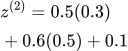
a^{(1)}=\begin{bmatrix}0.3\\0.5\end{bmatrix}Step 5: calculate the output preactivation. Use the activated hidden values as this layer's inputs.
 LaTeX:
z^{(2)}=0.5(0.3)+0.6(0.5)+0.1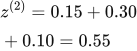 LaTeX:
z^{(2)}=0.15+0.30+0.10=0.55Step 6: apply the output activation.
 LaTeX:
\hat y=\max(0,0.55)=0.55Final answer: hidden preactivations and activations are [0.3, 0.5]ᵀ; output preactivation and prediction are both 0.55. They coincide here because every ReLU input is positive. No parameter has been updated during this forward pass.