Deep Learning · MT2 · section
What one artificial neuron does
Neural-network foundations
Definition. An artificial neuron is a calculation unit that multiplies each input by a matching weight, adds the products and a bias, and applies an activation function to produce its output.
What goes into a neuron?
An input is a number supplied to the calculation. With three inputs, x = [2,1,3] simply lists those three numbers in order. The matching weight list tells the neuron which multiplier to use for each input. A negative weight contributes a negative amount when its input is positive.
The bias is one extra adjustable number added to the total. The total before activation is called z or preactivation. The activation function is the final rule applied to z: for example, ReLU replaces a negative z with zero, while sigmoid turns z into a number between 0 and 1. The resulting output is called a or the activation.
Yaad rakhne ka cue: inputs × apne weights → products ka sum → ek bias → activation → output.
Mathematical model and notation
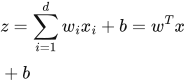 LaTeX:
z=\sum_{i=1}^{d}w_ix_i+b=w^Tx+b LaTeX:
a=f(z)| Symbol | Meaning and role |
|---|---|
| xᵢ | Input component i; the neuron receives d such components |
| wᵢ | Trainable weight multiplying that input component |
| b | Trainable bias added once to this neuron's total |
| z | Preactivation: the result before applying the activation function |
| f | Chosen activation function, such as sigmoid or ReLU |
| a | Activation: the neuron's output after applying f |
The dot product wᵀx is a compact notation for the sum of matching weight–input products. A positive weight and a negative weight can make opposite contributions for the same positive input. A larger weight magnitude means a larger contribution for a fixed input; it is not, by itself, a general measure of feature importance across differently scaled inputs.
Why both a bias and an activation are needed
The bias changes the preactivation independently of x. In a one-input affine function z = wx + b, it is the intercept. In a classifier with a decision boundary z = 0, a bias allows that boundary to be shifted instead of forcing it through the origin.
The activation determines how z is transformed. Sigmoid produces a value between 0 and 1; ReLU retains positive preactivations and sets negative ones to zero. Nonlinear activations let stacked layers represent nonlinear functions. The preactivation and activation are distinct quantities even when a particular ReLU calculation gives them equal values.
Worked numerical
Question. A neuron has x = [2, 1, 3]ᵀ, w = [0.4, −0.2, 0.5]ᵀ and b = 0.1. Calculate its preactivation and sigmoid output.
Given
Inputs = [2,1,3]; matching weights = [0.4,−0.2,0.5].
Bias = 0.1; activation = sigmoid.
To find
Find the preactivation z, then the sigmoid output.
Formula — which one and why
Weighted sum and activation. Each input is multiplied by its connection weight. Add these contributions, add the bias once, then apply the stated activation.
xᵢ = input i; wᵢ = its weight; b = bias; z = sum before activation; a = output after activation; f = the specified activation function.
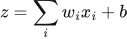 LaTeX:
z=\sum_iw_ix_i+bLaTeX: a=f(z)Yaad rakhne ka cue: Input × weight, sabka sum, bias once, phir activation.
Sigmoid output. The question specifies sigmoid, so turn the complete weighted sum into an output between 0 and 1. Negate z, evaluate the exponential, add 1, then take the reciprocal.
z = sum before activation; a = sigmoid output; e ≈ 2.71828 is the exponential base.
 LaTeX:
a=\frac1{1+e^{-z}}Yaad rakhne ka cue: Minus-z ki e power, plus one, phir one divided by whole denominator.
Solution — step by step
Step 1: multiply input 1 by weight 1.
 LaTeX:
x_1w_1=2(0.4)=0.8Step 2: multiply input 2 by weight 2.
 LaTeX:
x_2w_2=1(-0.2)=-0.2The minus sign belongs to the weight, so the contribution stays negative.
Step 3: multiply input 3 by weight 3.
 LaTeX:
x_3w_3=3(0.5)=1.5Step 4: add the three contributions.
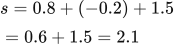 LaTeX:
s=0.8+(-0.2)+1.5=0.6+1.5=2.1Step 5: add the bias once.
 LaTeX:
z=s+b=2.1+0.1=2.2This is the preactivation. It is not yet the requested sigmoid output.
Step 6: negate z for the exponential.
 LaTeX:
-z=-2.2 LaTeX:
e^{-z}=e^{-2.2}\approx0.110803158Step 7: calculate the complete denominator.
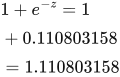 LaTeX:
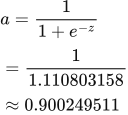
1+e^{-z}=1+0.110803158=1.110803158Step 8: divide one by that denominator.
 LaTeX:
a=\frac1{1+e^{-z}}=\frac1{1.110803158}\approx0.900249511Final answer: sigmoid output ≈ 0.900249511. It lies between 0 and 1. The raw sum was 2.2, whereas the activated output is approximately 0.90025.
From one neuron to a layer
With m receiving neurons and d input components, W has shape m × d. Row j contains the incoming weights of neuron j. The bias vector has m entries, one for each receiving neuron:
 LaTeX:
z=Wx+b,\qquad a=f(z)Sigmoid, tanh and ReLU apply independently to each component. Softmax is different: it transforms a whole vector of output logits together.
Neuron example 2: ReLU output
Question. A neuron receives inputs [2], weights [3] and bias 1. Calculate its preactivation and ReLU output.
Given
Inputs = [2].
Weights = [3]; bias = 1.
Activation = ReLU.
To find
z before activation and a after activation.
Formula — which one and why
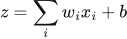
The weighted sum combines the inputs. The output must then use the activation explicitly requested.
z names the sum; a names the activated result. They are not always equal.
 LaTeX:
z=\sum_i w_ix_i+b LaTeX:
a=\max(0,z)Yaad rakhne ka cue: Sum alag, activation alag; activation lagana mat bhool.
Solution — step by step
Step 1: multiply input 1 by its own weight.
 LaTeX:
(2)(3)=6Step 2: add the input contributions.
 LaTeX:
s=(6)=6Step 3: add the bias once.
 LaTeX:
z=6+(1)=7Step 4: apply the stated activation.
 LaTeX:
a=\max(0,7)=7Final answer: z = 7; a = 7.
Neuron example 3: ReLU output
Question. A neuron receives inputs [2, 1], weights [-1, 0.5] and bias 0.2. Calculate its preactivation and ReLU output.
Given
Inputs = [2, 1].
Weights = [-1, 0.5]; bias = 0.2.
Activation = ReLU.
To find
z before activation and a after activation.
Formula — which one and why
The weighted sum combines the inputs. The output must then use the activation explicitly requested.
z names the sum; a names the activated result. They are not always equal.
LaTeX: z=\sum_i w_ix_i+bLaTeX: a=\max(0,z)Yaad rakhne ka cue: Sum alag, activation alag; activation lagana mat bhool.
Solution — step by step
Step 1: multiply input 1 by its own weight.
 LaTeX:
(2)(-1)=-2Step 2: multiply input 2 by its own weight.
 LaTeX:
(1)(0.5)=0.5Step 3: add the input contributions.
 LaTeX:
s=(-2)+(0.5)=-1.5Step 4: add the bias once.
 LaTeX:
z=-1.5+(0.2)=-1.3Step 5: apply the stated activation.
 LaTeX:
a=\max(0,-1.3)=0Final answer: z = -1.3; a = 0.
Neuron example 4: sigmoid output
Question. A neuron receives inputs [1, 2], weights [0.2, -0.1] and bias 0. Calculate its preactivation and sigmoid output.
Given
Inputs = [1, 2].
Weights = [0.2, -0.1]; bias = 0.
Activation = sigmoid.
To find
z before activation and a after activation.
Formula — which one and why
The weighted sum combines the inputs. The output must then use the activation explicitly requested.
z names the sum; a names the activated result. They are not always equal.
LaTeX: z=\sum_i w_ix_i+bLaTeX: a=\frac1{1+e^{-z}}Yaad rakhne ka cue: Sum alag, activation alag; activation lagana mat bhool.
Solution — step by step
Step 1: multiply input 1 by its own weight.
 LaTeX:
(1)(0.2)=0.2Step 2: multiply input 2 by its own weight.
 LaTeX:
(2)(-0.1)=-0.2Step 3: add the input contributions.
 LaTeX:
s=(0.2)+(-0.2)=0Step 4: add the bias once.
 LaTeX:
z=0+(0)=0Step 5: apply the stated activation.
 LaTeX:
a=\frac1{1+e^{0}}=\frac1{1+1}=0.5Final answer: z = 0; a = 0.5.