Deep Learning · MT2 · section
Activation functions and how to calculate them
Neural-network foundations
What an activation function does, and why it is needed
A neuron first produces the weighted sum z. The activation function f is a rule that transforms that sum into the output a = f(z). Applying an activation does not change the stored weights; it calculates a new output from the current sum.
If every layer only multiplies and adds, several layers still combine into a single affine transformation. A nonlinear activation lets the network represent more complicated relationships. The output activation must also suit the task: sigmoid for a binary-class probability, softmax for mutually exclusive class probabilities, and often a linear output for unrestricted regression.
The activation value says what the neuron outputs. The activation derivative says how quickly that output changes when z changes, which is needed during backpropagation. For sigmoid at z = 0, the value is 0.5 but the derivative is 0.25. They serve different purposes.
Yaad rakhne ka cue: z = activation se pehle ka sum; a = uske baad ka answer; f′ = answer kitni tezi se badlega.
Definition. An activation function maps a neuron's preactivation to its output. Nonlinear activations allow a multilayer network to represent nonlinear functions; the output activation also encodes the prediction type. Without a nonlinear activation, a composition of affine layers remains affine.
Explanation and working
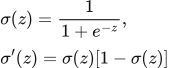 LaTeX:
\sigma(z)=\frac{1}{1+e^{-z}},\quad \sigma'(z)=\sigma(z)[1-\sigma(z)]Sigmoid converts any finite real input into a value strictly between 0 and 1. At zero it is 0.5. It is useful for a binary-class probability or independent multilabel outputs. At very positive or negative inputs it saturates, so its derivative becomes small. Its derivative is at most 0.25.
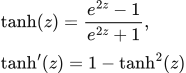 LaTeX:
\tanh(z)=\frac{e^{2z}-1}{e^{2z}+1},\quad \tanh'(z)=1-\tanh^2(z)Tanh lies between −1 and +1 and is zero-centered. It is common in recurrent hidden states. It also saturates. “Zero-centered” does not mean “no vanishing gradients”.
 LaTeX:
\operatorname{ReLU}(z)=\max(0,z),\quad f'(z)=\begin{cases}1&z>0\\0&z<0\end{cases}ReLU returns the input if positive and zero if negative. It is cheap to compute and has derivative 1 on its positive side. Units can become inactive on all relevant inputs, known as dying ReLU. At z = 0 the mathematical derivative is undefined; a convention such as 0 is used in implementations and this course’s exercises when needed.
 LaTeX:
\operatorname{LeakyReLU}(z)=\begin{cases}z&z\ge0\\az&z<0\end{cases},\qquad a=0.01\ \text{unless specified}The small negative slope a lets some gradient through for negative inputs. At z = −2 and a = 0.01, output = −0.02. Do not take the absolute value. PReLU learns the negative slope; Leaky ReLU normally fixes it.
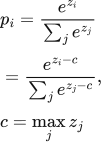 LaTeX:
p_i=\frac{e^{z_i}}{\sum_j e^{z_j}}=\frac{e^{z_i-c}}{\sum_j e^{z_j-c}},\qquad c=\max_jz_jSoftmax acts on a group of class scores, called logits. All probabilities are positive and sum to 1. Subtracting the same maximum c from all logits leaves the result unchanged and avoids very large exponentials. It is suited to mutually exclusive multiclass output.
Full softmax example. For [−1, 0, 1], exponentials are [0.367879, 1, 2.718282]. Sum = 4.086161. Divide each by that same sum: [0.090031, 0.244728, 0.665241]. Check their sum is approximately 1. Three separate sigmoids would give [0.268941, 0.5, 0.731059], which are different and do not sum to 1.
Derivation of the sigmoid derivative
Write sigmoid as a negative power. The outer derivative contributes −1, and differentiating the inner exponential contributes a second negative sign:
 LaTeX:
\sigma(z)=(1+e^{-z})^{-1}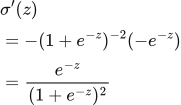 LaTeX:
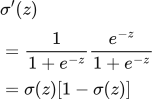
\sigma'(z)=-(1+e^{-z})^{-2}(-e^{-z})=\frac{e^{-z}}{(1+e^{-z})^2}Separate the expression into two factors:
 LaTeX:
\sigma'(z)=\frac{1}{1+e^{-z}}\frac{e^{-z}}{1+e^{-z}}=\sigma(z)[1-\sigma(z)]The second factor is 1−σ(z) because subtracting 1/(1+e⁻ᶻ) from 1 leaves e⁻ᶻ/(1+e⁻ᶻ). Once a forward pass has supplied σ(z), its derivative requires no further exponential evaluation.
Derivation of the tanh derivative
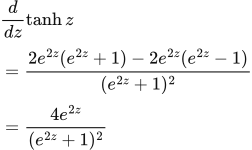
Use the quotient rule on the exponential definition. Here u = e²ᶻ−1 and v = e²ᶻ+1, with u′ = v′ = 2e²ᶻ.
 LaTeX:
\frac{d}{dz}\tanh z=\frac{2e^{2z}(e^{2z}+1)-2e^{2z}(e^{2z}-1)}{(e^{2z}+1)^2}=\frac{4e^{2z}}{(e^{2z}+1)^2}The identity 1−tanh²(z) gives the same expression, since the numerator becomes (e²ᶻ+1)²−(e²ᶻ−1)² = 4e²ᶻ. Therefore the backward-pass factor is 1−a² when a = tanh(z).
Why nonlinear activations are required
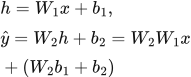
For two affine layers without a nonlinear activation:
 LaTeX:
h=W_1x+b_1,\qquad \hat y=W_2h+b_2=W_2W_1x+(W_2b_1+b_2)The composition is still one affine transformation. A nonlinear activation between layers changes the family of functions the network can represent. This is the mathematical reason for using nonlinear hidden activations; merely adding affine layers does not provide this expressive advantage.
sigmoid example 1
Question. For preactivation z = -2, calculate the sigmoid output and state its derivative.
Given
z = -2; activation = sigmoid.
To find
The output a and the derivative with respect to z.
Formula — which one and why
Use the activation named in the question. The derivative is a second calculation required for a backward pass.
z is the raw sum; a is the activated output; f′(z) is the local slope.
 LaTeX:
a=\frac1{1+e^{-z}} LaTeX:
f\prime(z)=a(1-a)Yaad rakhne ka cue: One over one plus e ki minus-z power; slope = output × (1−output).
Solution — step by step
Step 1: negate the whole input.
 LaTeX:
-z=-(-2)=2Step 2: calculate the exponential.
 LaTeX:
e^{2}\approx7.389056099Step 3: add one in the denominator.
 LaTeX:
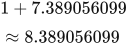
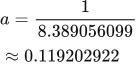
1+7.389056099\approx8.389056099Step 4: divide one by the complete denominator.
 LaTeX:
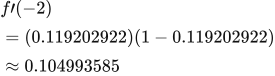
a=\frac1{8.389056099}\approx0.119202922Step 5: use the activated output in the slope.
 LaTeX:
f\prime(-2)=(0.119202922)(1-0.119202922)\approx0.104993585Final answer: a ≈ 0.119202922. Derivative ≈ 0.104993585.
sigmoid example 2
Question. For preactivation z = 0, calculate the sigmoid output and state its derivative.
Given
z = 0; activation = sigmoid.
To find
The output a and the derivative with respect to z.
Formula — which one and why
Use the activation named in the question. The derivative is a second calculation required for a backward pass.
z is the raw sum; a is the activated output; f′(z) is the local slope.
LaTeX: a=\frac1{1+e^{-z}}LaTeX: f\prime(z)=a(1-a)Yaad rakhne ka cue: One over one plus e ki minus-z power; slope = output × (1−output).
Solution — step by step
Step 1: negate the whole input.
 LaTeX:
-z=-(0)=0Step 2: calculate the exponential.
 LaTeX:
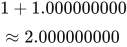
e^{0}\approx1.000000000Step 3: add one in the denominator.
 LaTeX:
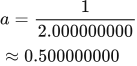
1+1.000000000\approx2.000000000Step 4: divide one by the complete denominator.
 LaTeX:
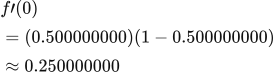
a=\frac1{2.000000000}\approx0.500000000Step 5: use the activated output in the slope.
 LaTeX:
f\prime(0)=(0.500000000)(1-0.500000000)\approx0.250000000Final answer: a ≈ 0.500000000. Derivative ≈ 0.250000000.
sigmoid example 3
Question. For preactivation z = 2, calculate the sigmoid output and state its derivative.
Given
z = 2; activation = sigmoid.
To find
The output a and the derivative with respect to z.
Formula — which one and why
Use the activation named in the question. The derivative is a second calculation required for a backward pass.
z is the raw sum; a is the activated output; f′(z) is the local slope.
LaTeX: a=\frac1{1+e^{-z}}LaTeX: f\prime(z)=a(1-a)Yaad rakhne ka cue: One over one plus e ki minus-z power; slope = output × (1−output).
Solution — step by step
Step 1: negate the whole input.
 LaTeX:
-z=-(2)=-2Step 2: calculate the exponential.
 LaTeX:
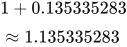
e^{-2}\approx0.135335283Step 3: add one in the denominator.
 LaTeX:
1+0.135335283\approx1.135335283Step 4: divide one by the complete denominator.
 LaTeX:
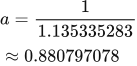
a=\frac1{1.135335283}\approx0.880797078Step 5: use the activated output in the slope.
 LaTeX:
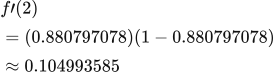
f\prime(2)=(0.880797078)(1-0.880797078)\approx0.104993585Final answer: a ≈ 0.880797078. Derivative ≈ 0.104993585.
tanh example 1
Question. For preactivation z = -2, calculate the tanh output and state its derivative.
Given
z = -2; activation = tanh.
To find
The output a and the derivative with respect to z.
Formula — which one and why
Use the activation named in the question. The derivative is a second calculation required for a backward pass.
z is the raw sum; a is the activated output; f′(z) is the local slope.
 LaTeX:
a=\frac{e^{2z}-1}{e^{2z}+1} LaTeX:
f\prime(z)=1-a^2Yaad rakhne ka cue: Tanh ka answer −1 se 1; slope one minus output squared.
Solution — step by step
Step 1: double z before exponentiation.
 LaTeX:
2z=2(-2)=-4Step 2: calculate the exponential.
 LaTeX:
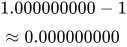
e^{-4}\approx0.018315639Step 3: calculate numerator and denominator separately.
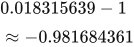 LaTeX:
0.018315639-1\approx-0.981684361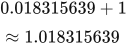 LaTeX:
0.018315639+1\approx1.018315639Step 4: divide.
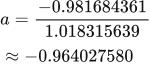 LaTeX:
a=\frac{-0.981684361}{1.018315639}\approx-0.964027580Step 5: square the activated output for its slope.
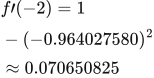 LaTeX:
f\prime(-2)=1-(-0.964027580)^2\approx0.070650825Final answer: a ≈ -0.964027580. Derivative ≈ 0.070650825.
tanh example 2
Question. For preactivation z = 0, calculate the tanh output and state its derivative.
Given
z = 0; activation = tanh.
To find
The output a and the derivative with respect to z.
Formula — which one and why
Use the activation named in the question. The derivative is a second calculation required for a backward pass.
z is the raw sum; a is the activated output; f′(z) is the local slope.
LaTeX: a=\frac{e^{2z}-1}{e^{2z}+1}LaTeX: f\prime(z)=1-a^2Yaad rakhne ka cue: Tanh ka answer −1 se 1; slope one minus output squared.
Solution — step by step
Step 1: double z before exponentiation.
 LaTeX:
2z=2(0)=0Step 2: calculate the exponential.
LaTeX: e^{0}\approx1.000000000Step 3: calculate numerator and denominator separately.
 LaTeX:
1.000000000-1\approx0.000000000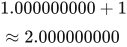 LaTeX:
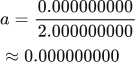
1.000000000+1\approx2.000000000Step 4: divide.
 LaTeX:
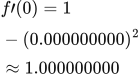
a=\frac{0.000000000}{2.000000000}\approx0.000000000Step 5: square the activated output for its slope.
 LaTeX:
f\prime(0)=1-(0.000000000)^2\approx1.000000000Final answer: a ≈ 0.000000000. Derivative ≈ 1.000000000.
tanh example 3
Question. For preactivation z = 2, calculate the tanh output and state its derivative.
Given
z = 2; activation = tanh.
To find
The output a and the derivative with respect to z.
Formula — which one and why
Use the activation named in the question. The derivative is a second calculation required for a backward pass.
z is the raw sum; a is the activated output; f′(z) is the local slope.
LaTeX: a=\frac{e^{2z}-1}{e^{2z}+1}LaTeX: f\prime(z)=1-a^2Yaad rakhne ka cue: Tanh ka answer −1 se 1; slope one minus output squared.
Solution — step by step
Step 1: double z before exponentiation.
 LaTeX:
2z=2(2)=4Step 2: calculate the exponential.
 LaTeX:
e^{4}\approx54.598150033Step 3: calculate numerator and denominator separately.
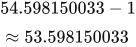 LaTeX:
54.598150033-1\approx53.598150033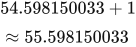 LaTeX:
54.598150033+1\approx55.598150033Step 4: divide.
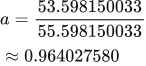 LaTeX:
a=\frac{53.598150033}{55.598150033}\approx0.964027580Step 5: square the activated output for its slope.
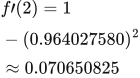 LaTeX:
f\prime(2)=1-(0.964027580)^2\approx0.070650825Final answer: a ≈ 0.964027580. Derivative ≈ 0.070650825.
ReLU example 1
Question. For preactivation z = -2, calculate the ReLU output and state its derivative.
Given
z = -2; activation = ReLU.
To find
The output a and the derivative with respect to z.
Formula — which one and why
Use the activation named in the question. The derivative is a second calculation required for a backward pass.
z is the raw sum; a is the activated output; f′(z) is the local slope.
 LaTeX:
a=\max(0,z)Yaad rakhne ka cue: Positive side slope 1; negative side ReLU 0, Leaky α. Zero par convention likho.
Solution — step by step
Step 1: select the branch from the sign of z.
-2 is negative, so use the negative branch.
Step 2: calculate the output.
 LaTeX:
a=0Step 3: state the slope on that branch.
 LaTeX:
f\prime(-2)=0Final answer: a ≈ 0.000000000. Derivative ≈ 0.000000000.
ReLU example 2
Question. For preactivation z = 0, calculate the ReLU output and state its derivative.
Given
z = 0; activation = ReLU.
To find
The output a and the derivative with respect to z.
Formula — which one and why
Use the activation named in the question. The derivative is a second calculation required for a backward pass.
z is the raw sum; a is the activated output; f′(z) is the local slope.
LaTeX: a=\max(0,z)Yaad rakhne ka cue: Positive side slope 1; negative side ReLU 0, Leaky α. Zero par convention likho.
Solution — step by step
Step 1: select the branch from the sign of z.
Both branches meet at zero. The value is zero, but the left and right slopes differ.
Step 2: calculate the output.
LaTeX: a=0Step 3: state the slope on that branch.
The ordinary derivative at zero does not exist. A software subgradient convention may choose a value such as 0; state it if required.
Final answer: a ≈ 0.000000000. Ordinary derivative is undefined at zero.
ReLU example 3
Question. For preactivation z = 2, calculate the ReLU output and state its derivative.
Given
z = 2; activation = ReLU.
To find
The output a and the derivative with respect to z.
Formula — which one and why
Use the activation named in the question. The derivative is a second calculation required for a backward pass.
z is the raw sum; a is the activated output; f′(z) is the local slope.
LaTeX: a=\max(0,z)Yaad rakhne ka cue: Positive side slope 1; negative side ReLU 0, Leaky α. Zero par convention likho.
Solution — step by step
Step 1: select the branch from the sign of z.
2 is positive, so retain it.
Step 2: calculate the output.
 LaTeX:
a=2Step 3: state the slope on that branch.
 LaTeX:
f\prime(2)=1Final answer: a ≈ 2.000000000. Derivative ≈ 1.000000000.
Leaky ReLU example 1
Question. For preactivation z = -2, calculate the Leaky ReLU output and state its derivative. Use negative-side slope α = 0.1.
Given
z = -2; activation = Leaky ReLU.
α = 0.1.
To find
The output a and the derivative with respect to z.
Formula — which one and why
Use the activation named in the question. The derivative is a second calculation required for a backward pass.
z is the raw sum; a is the activated output; f′(z) is the local slope.
 LaTeX:
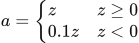
a=\begin{cases}z&z\ge0\\0.1z&z<0\end{cases}Yaad rakhne ka cue: Positive side slope 1; negative side ReLU 0, Leaky α. Zero par convention likho.
Solution — step by step
Step 1: select the branch from the sign of z.
-2 is negative, so use the negative branch.
Step 2: calculate the output.
 LaTeX:
a=-0.2Step 3: state the slope on that branch.
 LaTeX:
f\prime(-2)=0.1Final answer: a ≈ -0.200000000. Derivative ≈ 0.100000000.
Leaky ReLU example 2
Question. For preactivation z = 0, calculate the Leaky ReLU output and state its derivative. Use negative-side slope α = 0.1.
Given
z = 0; activation = Leaky ReLU.
α = 0.1.
To find
The output a and the derivative with respect to z.
Formula — which one and why
Use the activation named in the question. The derivative is a second calculation required for a backward pass.
z is the raw sum; a is the activated output; f′(z) is the local slope.
LaTeX: a=\begin{cases}z&z\ge0\\0.1z&z<0\end{cases}Yaad rakhne ka cue: Positive side slope 1; negative side ReLU 0, Leaky α. Zero par convention likho.
Solution — step by step
Step 1: select the branch from the sign of z.
Both branches meet at zero. The value is zero, but the left and right slopes differ.
Step 2: calculate the output.
LaTeX: a=0Step 3: state the slope on that branch.
The ordinary derivative at zero does not exist. A software subgradient convention may choose a value such as 0; state it if required.
Final answer: a ≈ 0.000000000. Ordinary derivative is undefined at zero.
Leaky ReLU example 3
Question. For preactivation z = 2, calculate the Leaky ReLU output and state its derivative. Use negative-side slope α = 0.1.
Given
z = 2; activation = Leaky ReLU.
α = 0.1.
To find
The output a and the derivative with respect to z.
Formula — which one and why
Use the activation named in the question. The derivative is a second calculation required for a backward pass.
z is the raw sum; a is the activated output; f′(z) is the local slope.
LaTeX: a=\begin{cases}z&z\ge0\\0.1z&z<0\end{cases}Yaad rakhne ka cue: Positive side slope 1; negative side ReLU 0, Leaky α. Zero par convention likho.
Solution — step by step
Step 1: select the branch from the sign of z.
2 is positive, so retain it.
Step 2: calculate the output.
LaTeX: a=2Step 3: state the slope on that branch.
LaTeX: f\prime(2)=1Final answer: a ≈ 2.000000000. Derivative ≈ 1.000000000.
Softmax for [0, 0, 0]
Question. Find stable softmax probabilities for logits [0, 0, 0].
Given
Logits = [0, 0, 0]; there are three mutually exclusive classes.
To find
All three class probabilities.
Formula — which one and why
Subtracting one common maximum preserves probabilities and keeps exponentials well scaled. Normalize using one shared sum.
A logit is a raw class score. c is the largest score; pᵢ is probability for class i.
 LaTeX:
c=\max_j z_j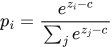 LaTeX:
p_i=\frac{e^{z_i-c}}{\sum_j e^{z_j-c}}Yaad rakhne ka cue: Max minus, e-power, same denominator se sab divide.
Solution — step by step
Step 1: subtract the largest score from every entry.
 LaTeX:
z-c=\begin{bmatrix}0&0&0\end{bmatrix}Step 2: exponentiate shifted entry 1.
LaTeX: e^{0}\approx1.000000000Step 3: exponentiate shifted entry 2.
LaTeX: e^{0}\approx1.000000000Step 4: exponentiate shifted entry 3.
LaTeX: e^{0}\approx1.000000000Step 5: add all exponentials into one denominator.
 LaTeX:
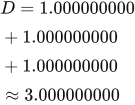
D=1.000000000+1.000000000+1.000000000\approx3.000000000Step 6: divide entry 1 by the same denominator.
 LaTeX:
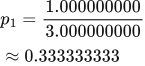
p_1=\frac{1.000000000}{3.000000000}\approx0.333333333Step 7: divide entry 2 by the same denominator.
 LaTeX:
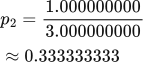
p_2=\frac{1.000000000}{3.000000000}\approx0.333333333Step 8: divide entry 3 by the same denominator.
 LaTeX:
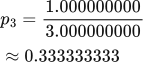
p_3=\frac{1.000000000}{3.000000000}\approx0.333333333Final answer: Probabilities ≈ [0.333333333, 0.333333333, 0.333333333]; they sum to 1 within rounding.
Softmax for [1, 2, 3]
Question. Find stable softmax probabilities for logits [1, 2, 3].
Given
Logits = [1, 2, 3]; there are three mutually exclusive classes.
To find
All three class probabilities.
Formula — which one and why
Subtracting one common maximum preserves probabilities and keeps exponentials well scaled. Normalize using one shared sum.
A logit is a raw class score. c is the largest score; pᵢ is probability for class i.
LaTeX: c=\max_j z_jLaTeX: p_i=\frac{e^{z_i-c}}{\sum_j e^{z_j-c}}Yaad rakhne ka cue: Max minus, e-power, same denominator se sab divide.
Solution — step by step
Step 1: subtract the largest score from every entry.
 LaTeX:
z-c=\begin{bmatrix}-2&-1&0\end{bmatrix}Step 2: exponentiate shifted entry 1.
LaTeX: e^{-2}\approx0.135335283Step 3: exponentiate shifted entry 2.
 LaTeX:
e^{-1}\approx0.367879441Step 4: exponentiate shifted entry 3.
LaTeX: e^{0}\approx1.000000000Step 5: add all exponentials into one denominator.
 LaTeX:
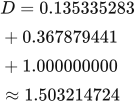
D=0.135335283+0.367879441+1.000000000\approx1.503214724Step 6: divide entry 1 by the same denominator.
 LaTeX:
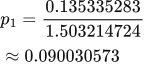
p_1=\frac{0.135335283}{1.503214724}\approx0.090030573Step 7: divide entry 2 by the same denominator.
 LaTeX:
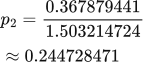
p_2=\frac{0.367879441}{1.503214724}\approx0.244728471Step 8: divide entry 3 by the same denominator.
 LaTeX:
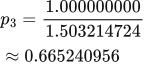
p_3=\frac{1.000000000}{1.503214724}\approx0.665240956Final answer: Probabilities ≈ [0.090030573, 0.244728471, 0.665240956]; they sum to 1 within rounding.