Deep Learning · MT2 · section
Inverted dropout during training and inference
Regularization and generalization
Definition. Inverted dropout divides retained training activations by their keep probability so that their expectation equals the original activation. At inference, dropout is disabled and no compensating activation scaling is required.
Explanation and working
Inverted dropout first chooses which activations to keep, then divides each kept activation by the keep probability. This compensates for the missing activations in expectation. A dropped activation becomes zero.
For activation 3 and keep probability q = 0.5, a kept value becomes 3 ÷ 0.5 = 6. A dropped value becomes 0. Since half the masks keep it, the average is 0.5 × 6 + 0.5 × 0 = 3, equal to the original activation.
At inference, dropout is disabled and the ordinary activation 3 is used. Under this inverted-dropout convention, no extra multiplication by q is required at inference.
Expectation calculation
For a fixed activation a and a Bernoulli keep mask m with P(m = 1) = q:
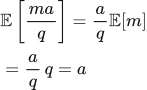 LaTeX:
\mathbb E\left[\frac{ma}{q}\right]=\frac aq\mathbb E[m]=\frac aq\,q=aThe equality concerns the activation's expectation over masks. It does not say every sampled layer preserves its sum, nor does it generally make a nonlinear network's complete stochastic prediction equal to its deterministic inference prediction.