Deep Learning · MT2 · section
Reading image shapes before doing CNN arithmetic
Convolutional neural networks
Definition. An image or intermediate CNN representation is a tensor indexed by spatial position and channel. This course writes its shape as height × width × channels, excluding the batch dimension.
Explanation and working
Height, width and channels
The shape 4 × 5 × 3 means 4 rows, 5 columns and 3 channels. It contains 4 × 5 × 3 = 60 numbers. A grayscale image commonly has one intensity channel; an RGB image has red, green and blue channels. Intermediate CNN channels are learned feature maps, not necessarily colors.
One position versus the whole map
A filter placed at one location computes one output value. Sliding that same filter over all valid locations creates one feature map. A second filter creates a second feature map. Therefore the number of filters equals the number of output channels.
Why filter depth matches input channels
A 3 × 3 filter applied to a 3-channel input has 3 × 3 × 3 = 27 weights. At one location, it combines 27 input values into one sum. A single bias is then added for that filter. It does not produce three separate output channels just because the input has three channels.
Reading a complete shape calculation
The spatial-size formula computes height and width. It does not compute the channel count.
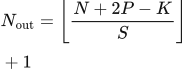 LaTeX:
N_{\mathrm{out}}=\left\lfloor\frac{N+2P-K}{S}\right\rfloor+1N = current input size; P = padding on one side; K = filter size; S = stride. The floor symbol means keep only complete placements. Add one because the initial placement is also an output position.
Shape, parameters and computation are three different counts
Shape counts the arrangement of output values. Parameters count learned weights and biases. Computation counts how many arithmetic operations are performed. Reusing the same filter at 100 positions creates 100 outputs but does not create 100 new sets of weights.
In a multi-layer question, write the output shape of a layer first. That becomes the next layer's input shape. This is why the second convolution uses the first convolution's channel count, not the original image's channel count.